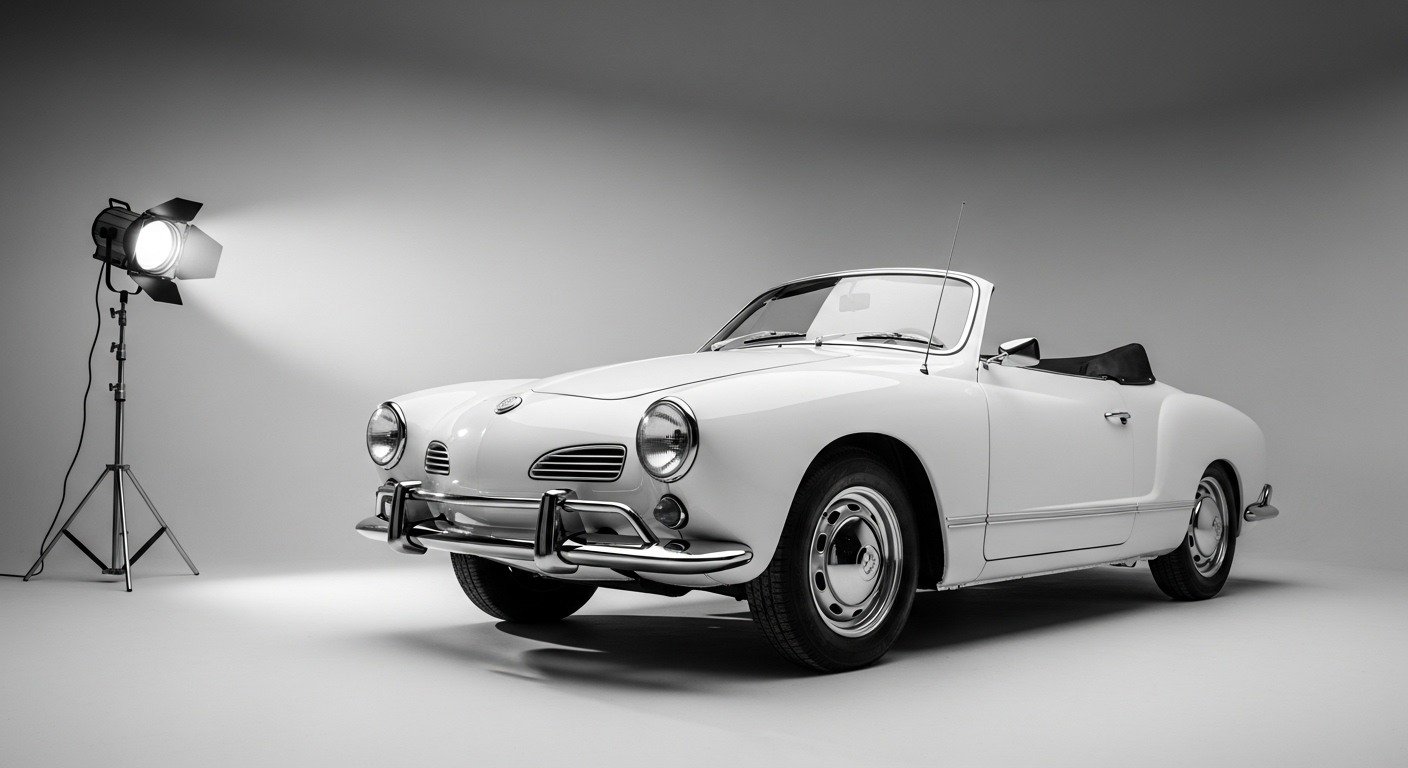
Coupe

1952 Type 14 Coupe

1600cc
Displacement
N/A
Power
N/A
Top Speed

Real Stories

VW Karmann Ghia 'lowlight' Debut

The Most Beautiful Car Nobody Was Supposed to Make

In 1952, Luigi Segre at Carrozzeria Ghia sketched a shape so beautiful that Volkswagen had to build it — even though they had no plans to. The Karmann Ghia was born: Italian grace on German bones, a car for people who wanted something extraordinary without ever raising their voice.

There was no plan for it. No marketing committee. No focus group. In 1952, a stylist named Luigi Segre at Turin's Carrozzeria Ghia put pencil to paper and drew the car he wanted to exist. The result was the Karmann Ghia — a coupe of such quiet elegance that it managed to make a 36-horsepower Beetle feel, somehow, aspirational.

Read the Full Story

Engineering.

The air-cooled flat-four that powered the 1952 Type 14 Coupe. Simple, reliable, and endlessly modifiable.

1600cc

Air-cooled

The air-cooled flat-four engine that powered a generation. Code .

Power
N/A
Fuel
Carburetor

Valuation Resources

Research current market values for the 1952 Type 14 Coupe

Buying tip: Condition is everything. A rusty "project" can cost more to restore than buying a finished car. Check heater channels, floor pans, and battery tray first.

Verify Authenticity

Numbers matching verification increases value by 20-40%. Use our tools to verify engine codes, chassis numbers, and M-codes for your 1952 Type 14 Coupe.

The Full Story

Introduction

There was no plan for it. No marketing committee. No focus group. In 1952, a stylist named Luigi Segre at Turin's Carrozzeria Ghia put pencil to paper and drew the car he wanted to exist. The result was the Karmann Ghia — a coupe of such quiet elegance that it managed to make a 36-horsepower Beetle feel, somehow, aspirational.

It was a collaboration that shouldn't have worked and somehow produced one of the most enduring shapes in automotive history. Ghia designed it. Wilhelm Karmann, the Osnabrück coachbuilder, built it by hand. Volkswagen provided the platform — and the nerve to say yes.

What It Was

The Karmann Ghia Coupe rode on a shortened Beetle floorpan, carrying Volkswagen's air-cooled flat-four engine tucked in the rear. The 1952 design concept used the existing 1.1-liter Beetle mechanicals as its canvas — modest by any measure, but the package that carried those underpinnings into the world was anything but.

Karmann's craftsmen in Osnabrück hand-finished each body, filling seams, shaping metal, coaxing the swooping Italian lines into production reality. No two were precisely identical. The dashboard was simple, the seats close-fitting, the cockpit intimate. This was not a car of performance specifications. It was a car of presence.

What Made It Special

What Ghia understood — what the whole improbable collaboration understood — was that beauty is its own engineering. The long hood, the tapered tail, the chrome strip that traced the flanks like a calligrapher's flourish: every line was drawn not to go fast but to make standing still look like movement.

The Karmann Ghia was the anti-sports car. It didn't pretend to be a Ferrari. It didn't need to. It was priced near the Beetle and looked like something parked outside a Milan café. No other manufacturer at any price point was offering that proposition. That was the genius of it — and the honesty of it too.

Cultural Context

Germany in 1952 was still putting itself back together. The Wirtschaftswunder — the economic miracle — was beginning to stir but hadn't yet arrived. Volkswagen was selling cars as fast as they could build them, mostly to people who needed transportation, not style. Against that backdrop, the Karmann Ghia design was an act of remarkable optimism.

In Italy that same year, Vespa was transforming scooters into symbols of freedom. In America, Eisenhower would win the presidency on a promise of calm. The world was reaching for normalcy — and for beauty — after years of ruin. A small, affordable, genuinely beautiful German automobile felt like exactly the right idea at exactly the right moment.

How It Drove

It drove like a Beetle — which is to say, with commitment and without apology. The torsion-bar suspension absorbed the road with willing compliance. The rear swing axle required a certain learned familiarity in corners. The brakes were drums all around, effective enough if you planned ahead. The engine note was that distinctive air-cooled clatter, honest and familiar.

Performance wasn't the point and was never advertised as such. What mattered was the ritual of driving it: the close-set seats, the small steering wheel, the view over that long hood. Every journey felt slightly more significant than it had any mechanical right to be.

Who Bought It

The Karmann Ghia found its audience among people who wanted to signal something about themselves without spending very much. Architects. Teachers. Young professionals in cities. People who had an eye but not a bank account to match it. In America, when it arrived, it appealed to women in a way the industry hadn't quite expected — here was a beautiful car at an honest price, with no condescension attached.

It was never a car for the performance crowd. Racing drivers bought Porsche. The Karmann Ghia was for people who understood that how something looks is not a frivolous concern.

Buying Today

Early Karmann Ghias are among the most desirable of all air-cooled Volkswagens, and values reflect it. Rust is the primary enemy — the complex body panels are expensive to repair correctly, and cutting corners shows. Seek cars with documented history and, ideally, uncut floors. The inner sills and battery tray are the first places to probe.

A concours-quality early coupe commands serious money. A solid driver needing cosmetic work is a more realistic entry point and can be deeply rewarding. The mechanical components are inexpensive and well-supported globally; the body is what costs. Invest in that first. Join a registry. These cars have devoted communities and parts suppliers who treat them with appropriate reverence.

The Verdict

The 1952 Karmann Ghia design represents one of the great acts of collaborative beauty in automotive history — a moment when a coachbuilder's dream, a designer's vision, and a manufacturer's willingness to take a chance all aligned at once.

It isn't fast. It isn't powerful. It is, quite simply, one of the most beautiful small cars ever drawn. That was enough in 1952. It's still enough now.