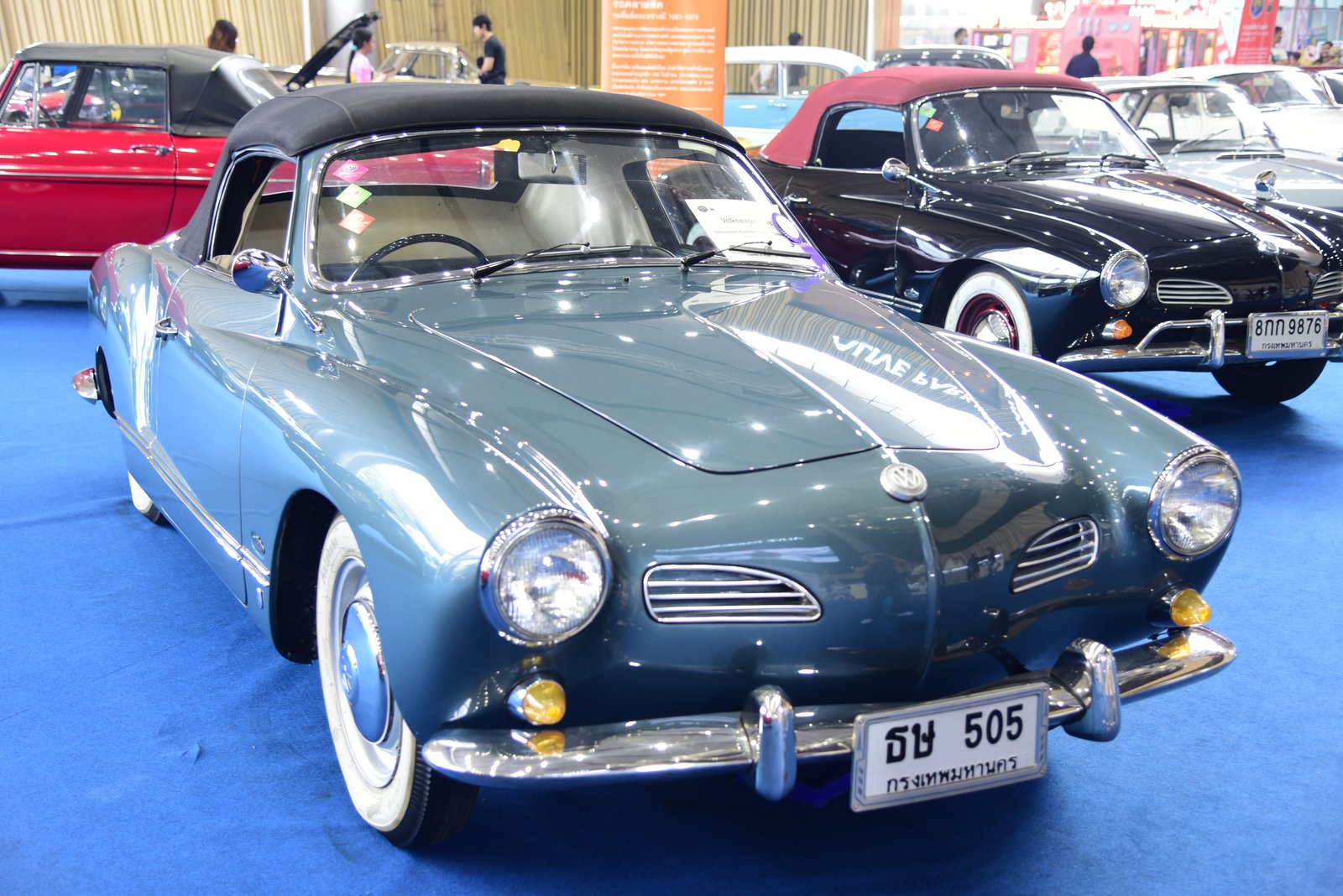
1963 Type 14 Coupe

1192cc • 34 HP • 2-door coupe

1963 Type 14 Coupe

The European-market 1963 Karmann Ghia Coupe wasn't imported. It was cultivated. Built for roads that curved through history, for drivers who understood that elegance was a form of discipline.

Real Stories

VW Karmann Ghia 'lowlight' Debut

Technical Specifications

Engine

Displacement
1192cc (1.192L)
Configuration
Air-cooled flat-4
Power
34 HP
Engine Code
M28

Performance

0-60 mph
N/A
Top Speed
N/A
Fuel Economy
N/A

Drivetrain

Transmission
4-speed manual
Drive Type
RWD

Chassis

Front Suspension
Torsion bar
Rear Suspension
Swing axle
Brakes
Drum front and rear
Steering
Worm and roller

Dimensions

Factory Colors

Black
L41
Gulf Blue
L390

Verify Authenticity

Numbers matching verification increases value by 20-40%. Use our interactive tools to verify engine codes, chassis numbers, and M-codes against production data for your 1963 Type 14 Coupe.

Correct Engine Code
M28
Valid Engine Codes
M28

The Full Story

Swipe to explore the story of the 1963 Type 14 Coupe

Image placeholder

Introduction

By 1963, the European-market Karmann Ghia Coupe had found its identity completely separate from its American counterpart. This wasn't an import struggling for acceptance, it was the refined evolution of a philosophy that had been proven year after year in European markets. The 1963 model arrived at a moment when British and Italian sports cars dominated the conversation, yet somehow this humble Volkswagen derivative continued selling steadily. It represented something those faster cars didn't: accessible sophistication for the thinking driver.

What It Was

The 1963 Coupe embodied a specific moment in European design aesthetics. The body panels showed Karmann's hand-crafted precision, the proportions had settled into something definitively elegant, and the overall impression was of intentional simplicity. Where 1960s design was beginning to embrace extravagant styling, the Karmann Ghia remained fundamentally conservative. That conservatism wasn't limitation, it was conviction. The steering wheel, the instrument cluster, the seat arrangement all reflected the belief that function and form need not be separated.

And what Karmann did was extraordinary. Each body panel was hand-formed, hand-fitted, hand-finished. The gaps were measured. The seams were checked. In an era of mass production, Karmann was building each coupe the way a tailor builds a suit — with attention to the individual, not the assembly. Ghia's Turin studio had given them curves that defied easy stamping, so Karmann's craftsmen shaped the steel by hand and fitted it with patience. The result looked like it cost three times what it did.

Image placeholder
Image placeholder

What Made It Special

The 1600cc engine remained unchanged from earlier models, but by 1963 this continuity meant something: proven reliability. The 4-speed manual was becoming standard across manufacturers, yet in the Karmann Ghia it felt like thoughtful choice rather than limitation. Torsion bar suspension gave the 1963 model a ride that felt planted and confident on European roads, whether narrow Alpine passes or open autobahns. The eXperience prioritized involvement over comfort, engagement over isolation.

The roofline was where Ghia earned their fee. That long, low sweep from the A-pillar to the tail wasn't accidental geometry — it was sculpture. It made the car look like it was moving even when parked, which is the whole point.

The interior was simple and exactly right. The dashboard organized information without fuss. The seats held you in place. The steering wheel — thin-rimmed, leather-wrapped on better-equipped cars — felt like it belonged in your hands. VW had learned, from building millions of Beetles, that people wanted reliability. Karmann had added that reliability could also be beautiful.

Cultural Context

1963 was the year innocence started its long goodbye. The Beatles were on every radio. Zip codes arrived. The space race accelerated. And in the gap between postwar optimism and whatever came next, the Karmann Ghia held its form with something like grace.

1963 was the year innocence started its long goodbye. The Beatles were on every radio. Zip codes arrived. The space race accelerated. And in the gap between postwar optimism and whatever came next, the Karmann Ghia held its form with something like grace.

The Karmann Ghia didn't participate in the cultural conversation of 1963 — it enabled it. A reliable, stylish, affordable car let its owners show up to the things that mattered.

Image placeholder
Image placeholder

How It Drove

Nobody bought a Karmann Ghia for the acceleration. With 34 horsepower from an air-cooled four, zero to sixty was a process rather than an event — somewhere in the twelve-to-fourteen-second range depending on conditions. On the highway, the engine spun freely and reached highway speeds with philosophical acceptance. There was a particular pleasure in running flat-out in fourth gear knowing that flat-out was 75 miles per hour and entirely sustainable.

What the Ghia did remarkably well was corners. The low center of gravity (that flat-four sat low and behind the rear axle) combined with the torsion bar front suspension produced handling that rewarded attention without punishing inattention. The car communicated. It told you when you were pushing it and accepted the information gracefully. The swing axle rear could get lively if you truly provoked it, but you had to work at provocation.

The gearbox was a delight. The four speeds were well-spaced, the shift action precise, the clutch light and progressive. Driving a Karmann Ghia in traffic was genuinely pleasant — no heavy clutch, no vague steering, no sense that the car was too large for the space it occupied. It was, among other things, exactly the right size.

Who Bought It

The first wave of Baby Boomers entering the job market. Young women establishing independence — the Ghia was often their first car, not their husband's second. Professors. Photographers. The kind of person who owned a portable record player and knew all of Miles Davis's albums.

The Karmann Ghia cost more than a Beetle and significantly less than a Porsche 356 — a price point that attracted buyers who understood they were getting European design at a reasonable premium, not a sports car at a bargain. The typical owner drove it daily, maintained it conscientiously, and kept it longer than they kept most things. These were not impulse purchases.

Women bought Karmann Ghias in numbers that surprised the automotive press, which had assumed the sports-car-adjacent styling would attract a male demographic. It didn't, or not exclusively. The Ghia appealed to anyone who wanted a car that was beautiful and reliable without requiring a mechanic's license to operate — and by 1963, that population had grown considerably.

Image placeholder
Image placeholder

Buying Today

1963 marks an important transition year. Production was hitting stride — roughly 1,000 units per month by year's end. The 40-hp 1200cc engine was a meaningful upgrade. Today, clean 1963 coupes run $17,000–$33,000; exceptional restorations $45,000–$65,000. Euro-market variants are rarer and command a premium. Convertibles: add 30%.

What to inspect: rust first, always. The floorpans, the spare tire well, the battery tray, the heater channels that run the length of the car. Karmann's hand-formed panels were beautiful but required consistent maintenance to stay that way. A car that was neglected in the 1980s has likely suffered. A car that was garaged and serviced regularly in the 1970s is probably still solid.

The mechanicals are forgiving. The air-cooled engines are well-understood, parts are available, and any competent VW specialist can service them. The 4-speed gearbox is robust. The electrical system is simple by design — what can go wrong has been catalogued thoroughly by fifty years of enthusiast ownership. The Karmann Ghia Owners Association and VW community are genuinely helpful. Join them before you buy.

The Verdict

The 1963 Karmann Ghia coupe is not the fastest car you'll ever own. Not the most powerful. Not the most technologically sophisticated. When this car was new, the muscle car era was still gathering momentum, and the Ghia was happily uninvited.

What it is: a car that was made by hand, shaped by people who cared about proportions, and designed by a studio in Turin that was asked to make a Beetle beautiful and succeeded beyond anyone's reasonable expectation. Italian design, German craft, mechanical simplicity — the combination has aged with remarkable grace.

Sixty years on, the Karmann Ghia still turns heads. Not because it's exotic or rare, but because it's right. The proportions are right. The scale is right. The idea that a car could be elegant and honest simultaneously, that beauty didn't require pretension — that idea is still right. Buy a good one. Drive it. You'll understand immediately what all the fuss was about.

Image placeholder
Swipe or use arrow keys to explore

Browse by Year