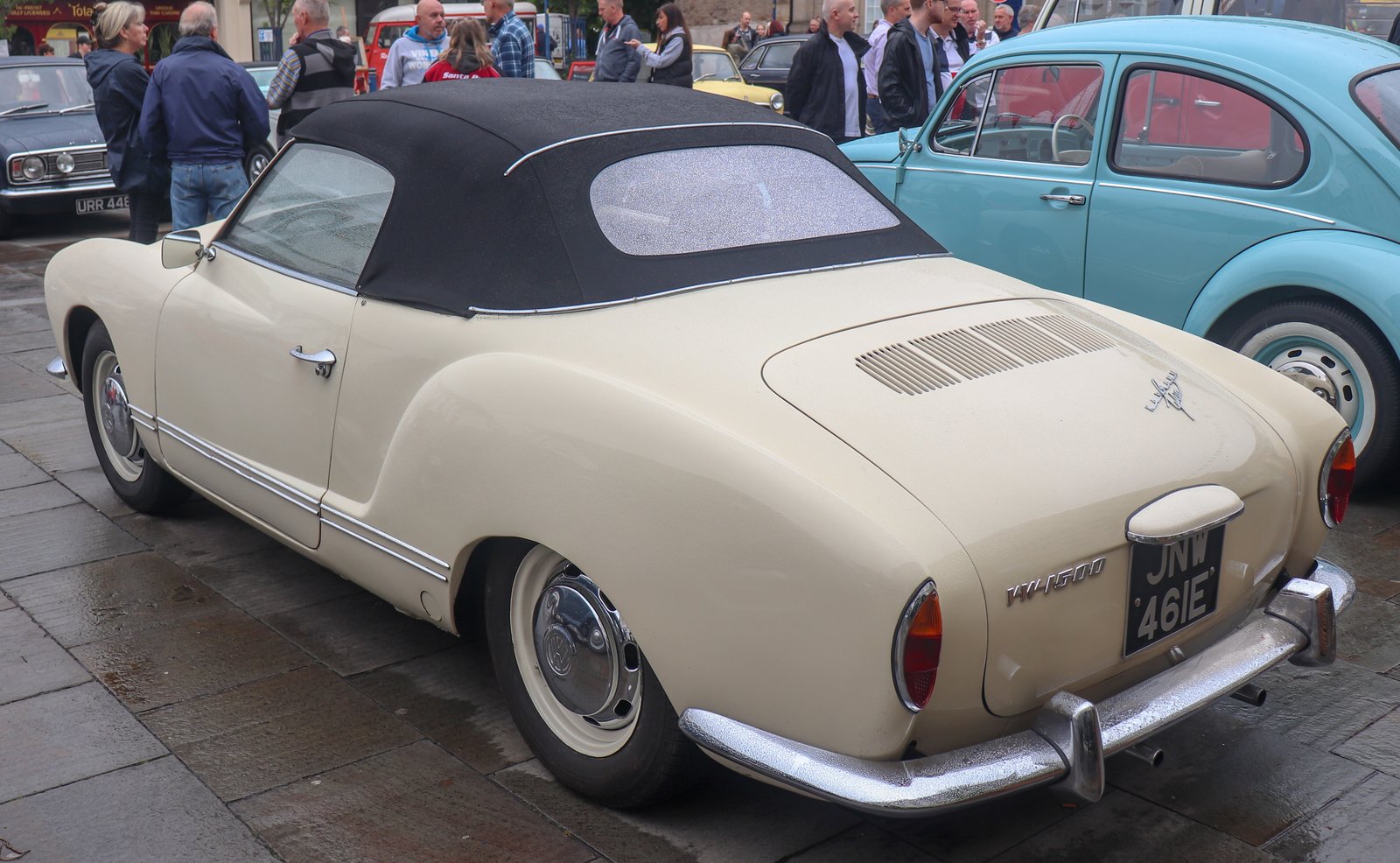
1967 Type 14 Coupe

1493cc • 44 HP • 2-door coupe

1967 Type 14 Coupe

Summer of Love, 1967. Sgt. Pepper's on every turntable. The world trying to decide between Haight-Ashbury and the establishment. The Karmann Ghia coupe declined to choose. It just drove — beautifully, reliably, quietly.

Real Stories

VW Karmann Ghia 'lowlight' Debut

Technical Specifications

Engine

Displacement
1493cc (1.493L)
Configuration
Air-cooled flat-4
Power
44 HP
Engine Code
H

Performance

0-60 mph
N/A
Top Speed
N/A
Fuel Economy
N/A

Drivetrain

Transmission
4-speed manual
Drive Type
RWD

Chassis

Front Suspension
Torsion bar
Rear Suspension
Swing axle
Brakes
Drum front and rear
Steering
Worm and roller

Dimensions

Factory Colors

Black
L41
Fontana Grey
L595
Ruby Red
L456

Verify Authenticity

Numbers matching verification increases value by 20-40%. Use our interactive tools to verify engine codes, chassis numbers, and M-codes against production data for your 1967 Type 14 Coupe.

Correct Engine Code
H
Valid Engine Codes
H

The Full Story

Swipe to explore the story of the 1967 Type 14 Coupe

Image placeholder

Introduction

Summer of Love. Sgt. Pepper's. The first Super Bowl. Muhammad Ali refused the draft. Thurgood Marshall on the Supreme Court. Detroit burned. The world was splitting between the beautiful and the urgent, and people had to choose which lane they drove in.

Into this world came the 1967 Karmann Ghia coupe. Not with fanfare. Not with a press release that promised revolution. Just with the same Italian curves that Ghia had drawn in Turin, the same hand-fitted steel that Karmann had shaped in Osnabrück, and the same air-cooled flat-four that had proven itself in the Beetle. An anti-sports car for people with better things to argue about.

What It Was

The Karmann Ghia Type 14 was, technically, a Volkswagen. The platform was pure Beetle: the floorpan, the 1600cc air-cooled flat-four producing modest but proven horsepower, the torsion bar front suspension, the swing axle rear. VW supplied the running gear and the platform warranty. Karmann in Osnabrück did the rest.

And what Karmann did was extraordinary. Each body panel was hand-formed, hand-fitted, hand-finished. The gaps were measured. The seams were checked. In an era of mass production, Karmann was building each coupe the way a tailor builds a suit — with attention to the individual, not the assembly. Ghia's Turin studio had given them curves that defied easy stamping, so Karmann's craftsmen shaped the steel by hand and fitted it with patience. The result looked like it cost three times what it did.

Image placeholder
Image placeholder

What Made It Special

The 4-speed manual transmission meant driving was a conversation, not a monologue. The steering — worm and roller, direct and honest — told you what the front wheels were thinking. The torsion bar suspension absorbed the road without drama. Nothing in the Karmann Ghia tried to hide what it was doing.

The roofline was where Ghia earned their fee. That long, low sweep from the A-pillar to the tail wasn't accidental geometry — it was sculpture. It made the car look like it was moving even when parked, which is the whole point.

The interior was simple and exactly right. The dashboard organized information without fuss. The seats held you in place. The steering wheel — thin-rimmed, leather-wrapped on better-equipped cars — felt like it belonged in your hands. VW had learned, from building millions of Beetles, that people wanted reliability. Karmann had added that reliability could also be beautiful.

Cultural Context

1967 was the year two Americas stared at each other from opposite sides of the generational divide. The hippies had their summer, the establishment had its anxiety, and caught between them was a car that had always refused to be political but somehow felt, to people on both sides, exactly right.

The Karmann Ghia didn't participate in the cultural conversation of 1967 — it enabled it. A reliable, stylish, affordable car let its owners show up to the things that mattered. The civil rights marches and folk concerts and teach-ins and gallery openings. The Ghia was transportation for people who took their interior lives seriously.

Image placeholder
Image placeholder

How It Drove

Nobody bought a Karmann Ghia for the acceleration. With 34–40 horsepower from an air-cooled four, zero to sixty was a process rather than an event — somewhere in the twelve-to-fourteen-second range depending on conditions. On the highway, the engine spun freely and reached highway speeds with philosophical acceptance. There was a particular pleasure in running flat-out in fourth gear knowing that flat-out was 75 miles per hour and entirely sustainable.

What the Ghia did remarkably well was corners. The low center of gravity (that flat-four sat low and behind the rear axle) combined with the torsion bar front suspension produced handling that rewarded attention without punishing inattention. The car communicated. It told you when you were pushing it and accepted the information gracefully. The swing axle rear could get lively if you truly provoked it, but you had to work at provocation.

The gearbox was a delight. The four speeds were well-spaced, the shift action precise, the clutch light and progressive. Driving a Karmann Ghia in traffic was genuinely pleasant — no heavy clutch, no vague steering, no sense that the car was too large for the space it occupied. It was, among other things, exactly the right size.

Who Bought It

Anyone who wanted out. Out of the muscle car race, out of the status competition, out of the noise. The Karmann Ghia in 1967 attracted the same counterculture buyers as always — but also their parents, who'd grown tired of everything being a statement. It was the car for people who just wanted to drive.

The Karmann Ghia cost more than a Beetle and significantly less than a Porsche 356 — a price point that attracted buyers who understood they were getting European design at a reasonable premium, not a sports car at a bargain. The typical owner drove it daily, maintained it conscientiously, and kept it longer than they kept most things. These were not impulse purchases.

Women bought Karmann Ghias in numbers that surprised the automotive press, which had assumed the sports-car-adjacent styling would attract a male demographic. It didn't, or not exclusively. The Ghia appealed to anyone who wanted a car that was beautiful and reliable without requiring a mechanic's license to operate — and by 1967, that population had grown considerably.

Image placeholder
Image placeholder

Buying Today

The 1967 model year brought the 1500cc engine (44 hp) to most markets — an important upgrade that improved highway cruising significantly. These are the last pre-big-bumper Ghias, maintaining the clean original lines. Values: $20,000–$42,000 for solid coupes; $28,000–$58,000 for convertibles. The 1500cc engine is increasingly favored for touring use.

What to inspect: rust first, always. The floorpans, the spare tire well, the battery tray, the heater channels that run the length of the car. Karmann's hand-formed panels were beautiful but required consistent maintenance to stay that way. A car that was neglected in the 1980s has likely suffered. A car that was garaged and serviced regularly in the 1970s is probably still solid.

The mechanicals are forgiving. The air-cooled engines are well-understood, parts are available, and any competent VW specialist can service them. The 4-speed gearbox is robust. The electrical system is simple by design — what can go wrong has been catalogued thoroughly by fifty years of enthusiast ownership. The Karmann Ghia Owners Association and VW community are genuinely helpful. Join them before you buy.

The Verdict

The 1967 Karmann Ghia coupe is not the fastest car you'll ever own. Not the most powerful. Not the most technologically sophisticated. By the time this car was built, the muscle car era had already decided what American performance meant, and the Ghia was nowhere near that conversation.

What it is: a car that was made by hand, shaped by people who cared about proportions, and designed by a studio in Turin that was asked to make a Beetle beautiful and succeeded beyond anyone's reasonable expectation. Italian design, German craft, mechanical simplicity — the combination has aged with remarkable grace.

Sixty years on, the Karmann Ghia still turns heads. Not because it's exotic or rare, but because it's right. The proportions are right. The scale is right. The idea that a car could be elegant and honest simultaneously, that beauty didn't require pretension — that idea is still right. Buy a good one. Drive it. You'll understand immediately what all the fuss was about.

Image placeholder
Swipe or use arrow keys to explore

Browse by Year