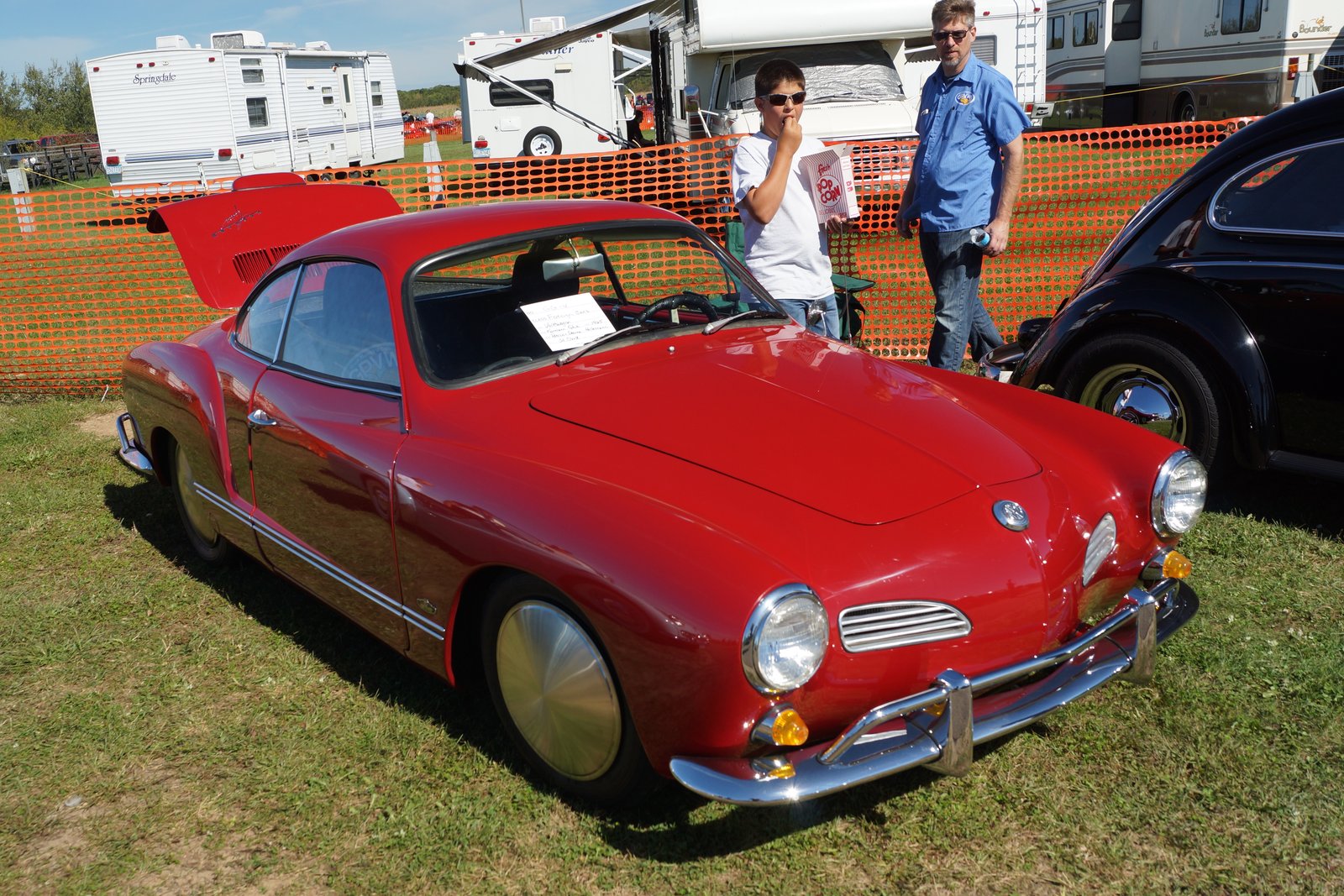
1965 Type 34

1493cc • 45 HP • 2-door coupe

1965 Type 34

The 1965 Type 34 Karmann Ghia represented the 'Razor Edge' design philosophy at full maturity — sharper proportions, more purposeful positioning, a deliberate statement that this was a European luxury car that didn't apologize for anything.

Real Stories

VW Karmann Ghia 'lowlight' Debut

Technical Specifications

Engine

Displacement
1493cc (1.493L)
Configuration
Air-cooled flat-4 'pancake' engine
Power
45 HP
Engine Code
D / U

Performance

0-60 mph
N/A
Top Speed
N/A
Fuel Economy
N/A

Drivetrain

Transmission
4-speed manual
Drive Type
RWD

Chassis

Front Suspension
Torsion bar
Rear Suspension
Swing axle
Brakes
Drum front and rear
Steering
Worm and roller

Dimensions

Factory Colors

Black
L41
Fontana Grey
L595

Verify Authenticity

Numbers matching verification increases value by 20-40%. Use our interactive tools to verify engine codes, chassis numbers, and M-codes against production data for your 1965 Type 34.

Correct Engine Code
D / U
Valid Engine Codes
D / U

The Full Story

Swipe to explore the story of the 1965 Type 34

Image placeholder

Introduction

The 1965 Type 34 Karmann Ghia represented a deliberate divergence from its Type 14 sibling. Where the Type 14 embraced curves and compromise, the Type 34 embraced the 'Razor Edge' design philosophy — sharper proportions, more aggressive positioning, and a deliberate statement that this was a European luxury car, not an American import.

The 1965 model arrived at the peak of this platform's evolution, incorporating five years of refinement while maintaining the distinctive angular design that set it apart on any European road. By 1965, the car knew what it was. That confidence came through in every line.

What It Was

The Type 34's distinguishing feature was its more angular approach to proportion and line. The hood line, the side profile, the window design all embraced geometry over curves. This wasn't merely stylistic — it was philosophical. The Razor Edge design said: 'We know exactly what we are, and we're not apologizing.' The 1965 model refined these proportions further; the side panels showing increasing sophistication in their crease patterns, the overall silhouette feeling more confident than earlier Type 34s.

European buyers understood immediately that this car occupied a different market position than the Type 14. This was VW's most sophisticated product — the one built for buyers who could tell the difference.

Image placeholder
Image placeholder

What Made It Special

The 1600cc engine in the 1965 Type 34 produced the same 60 horsepower as its curved sibling, but in the context of the sharper body and more performance-oriented positioning, that power felt better utilized. The four-speed manual paired with the slightly tighter chassis delivered an experience that felt more connected, more responsive to driver input.

The suspension geometry remained torsion bars, but the stiffer mounting and tuning meant the Type 34 handled with noticeably different character than the Type 14. This wasn't just a different body on familiar mechanics — this was a different approach to what those mechanics could deliver. Around 42,000 total Type 34s were ever built. The 1965 cars represent the platform at its most assured.

Cultural Context

1965: European confidence was rising. The British Invasion had reshaped popular culture. European cinema — Godard, Antonioni, Bergman — was establishing independent voices that didn't defer to Hollywood. European fashion, European design, European everything was ascendant. And European manufacturers were beginning to challenge American automotive assumptions with the straightforward argument that quality and elegance mattered more than volume and spectacle.

The Type 34 arrived as distinctly European, uninterested in American market preferences, designed explicitly for buyers who wanted something clearly distinct from the mainstream. That explicit positioning — in an era when Europe was culturally ascendant — gave the Type 34 a particular appeal.

Original buyers in 1965 saw the Type 34 as the more sophisticated choice, the sharper statement, the European alternative that didn't apologize. Decades later, when the air-cooled VW community discovered these cars, the Type 34's angular design felt modern in ways the curved Type 14 didn't — proof that good design transcends fashion cycles.

Image placeholder
Image placeholder

How It Drove

The 1965 Type 34 interior reflected its positioning more explicitly than the Type 14. Upholstery materials were often more refined, instrumentation more comprehensive, and overall organization more businesslike. Where the Type 14 suggested leisure and Italian coastal living, the Type 34 suggested purpose and professional accomplishment.

The driving position felt more executive, the sight lines more commanding, the controls more precise in their response. The 1600cc engine's power delivery was smooth and linear — not exciting, but competent in a way that felt appropriate for a car making an argument about sophistication rather than performance.

Who Bought It

The 1965 Type 34 Karmann Ghia, particularly the Razor Edge variants, represents a specific historical moment when European automotive philosophy was asserting itself globally. The angular design that felt cutting-edge in 1965 remains geometrically interesting; the mechanical simplicity that felt liberating then feels revolutionary now.

Collectors specifically seek Type 34 examples for their design distinctiveness and the philosophical clarity they represent. The people who bought them new were design-conscious, sophisticated buyers who found the Type 14's popularity slightly beside the point. The people who collect them now feel similarly.

Image placeholder
Image placeholder

Buying Today

The 1965 Type 34 sits at the heart of the production run — past the early development years, before the late-production refinements that preceded the 1969 end. The 1600cc engine was standard by this point, making 1965 cars the most complete expression of the original design vision.

Body panels are Type 34 specific and not interchangeable with Type 14 components — confirm this with any supplier before ordering. Rust evaluation should concentrate on lower sills, floor pans, and the front and rear valance areas. A well-documented 1965 Type 34 with verifiable history commands significant collector premium.

Check Hagerty (hagerty.com) for current market values. The Type 34 market has strengthened considerably as the air-cooled collector community has come to understand what 42,000 total production actually means — real rarity, properly valued.

The Verdict

The 1965 Type 34 Karmann Ghia is the Razor Edge at full confidence. It had found its proportions, refined its execution, and was making its argument with complete assurance: elegance through discipline. Beauty through geometry. Sophistication through restraint.

What makes 1965 Type 34s increasingly valuable isn't just scarcity — though 42,000 total builds across a seven-year production run is genuinely scarce. It's that design this deliberate and uncompromising becomes more meaningful with time. Every year that passes, the conviction required to build this car in 1965 becomes more apparent.

Own one and you own the argument at its most articulate.

Image placeholder
Swipe or use arrow keys to explore

Browse by Year