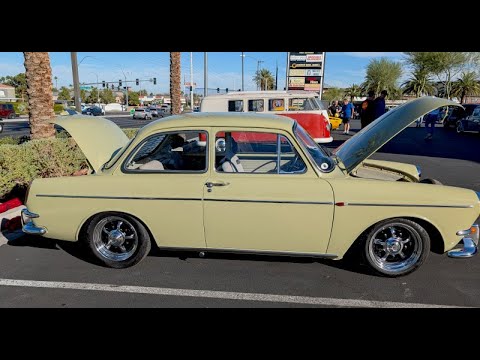
1600cc • Sedan

1960 Notchback (Type 3)

The 1960 Type 3 Notchback was Volkswagen's first serious attempt to move beyond the Beetle — a sober, sophisticated family car that hid its engineering innovations beneath a deceptively modest exterior.

Real Stories

1964 VW Notchback

The Story

olkswagen had a problem. The Beetle was a phenomenon — a cultural object, a sales miracle, a car that had charmed the world by refusing to pretend it was something it wasn't. But families were growing. Postwar prosperity was arriving. People needed more room, more trunk, more car. The Beetle couldn't give it to them.

In 1960, Volkswagen's answer was the Type 3 Notchback. Not flashy. Not romantic. Not a car you'd put on a poster. But quietly, methodically, sensibly excellent — the way Germany was rebuilding itself in the late 1950s, one careful decision at a time.

Model Information and History

What It Was

The 1960 Notchback was revolutionary and cautious simultaneously. The body was square-edged and practical — nothing like the curved sweetness of the Beetle. The greenhouse was larger, the windows bigger, the interior genuinely usable for a family of four plus luggage.

Yet the design language was conservative: simple lines, minimal ornamentation, a shape that communicated function rather than emotion. This was a car designed for families and practical people, not enthusiasts. Under the skin, the Type 3's 1500cc flat-four was mounted horizontally — a package so flat it created usable trunk space at both ends. Front trunk. Rear trunk. An engineering solution disguised as a sensible sedan.

These weren't revolutionary technologies, but their combination represented serious engineering thought applied to family car design. VW was proving it could think beyond the Beetle without abandoning what made the Beetle work.

What Made It Special

The Type 3 introduced several innovations: the 1500cc flat-four mounted horizontally, dual trunk spaces front and rear — a genuine engineering achievement in 1960. The flat engine was the masterstroke: by lying it on its side, engineers created a rear cargo area that actually held things.

It was less playful than a Beetle, less romantic than a Karmann Ghia, but more practical than either. For someone who needed a car to work — raising children, hauling groceries, commuting reliably — it delivered without drama, which was precisely its character.

Cultural Context

1960: West Germany's Wirtschaftswunder — the economic miracle — was no longer a miracle. It was simply reality. Families were moving into new apartments, buying televisions, taking modest vacations. The rubble of the 1940s had been replaced by something quieter and more durable: steady prosperity.

The Type 3 Notchback spoke to this moment perfectly. It was modern design language without excess. Function without compromise. German engineering applied to practical transportation. It wasn't trying to be the Autobahn's sports car or the showroom's trophy. It was trying to be the car that got your family where they needed to go, then did it again tomorrow.

Across the Atlantic, 1960 meant tail fins and chrome and cars that looked like they were trying to escape gravity. The Notchback was the quiet rebuttal — the car that said elegance might just be the absence of unnecessary things.

How It Drove

For a family, the Type 3 Notchback was genuinely useful. The rear seat was properly sized. The trunk was practical. The windows offered good visibility. The driving position was more conventional than the Beetle — you sat in it rather than on top of it.

The 1500cc engine delivered consistent rather than exciting performance. Highway cruising felt entirely civilized. The four-speed gearbox shifted with that characteristic VW precision. The torsion bar suspension absorbed German roads without complaint. A car that worked — which was precisely what the market wanted.

Who Bought It

The early Type 3 buyer was, broadly, the person who had graduated from the Beetle. Young families who'd started with something small and simple and now needed more. Professionals who wanted German reliability with room for a briefcase and a suit in the back. Pragmatists who read the specs before reading the brochure.

In West Germany, the Notchback was the respectable choice — the car that said you were doing well without shouting about it. It found buyers among teachers, engineers, civil servants, and anyone who understood that the most sophisticated statement is often the least dramatic one.

In export markets, particularly where VW had established the Beetle as trustworthy, the Type 3 offered a natural step up. You already knew the engine. You already trusted the brand. This was simply more of what worked.

Buying Today

The Type 3 Notchback debuted in 1960 and continued through 1969. Early examples — the 1960-1963 cars — are the rarest and most historically significant, predating the 1500S engine and the later refinements that made the Type 3 a more complete package.

These early cars suffer from the same vulnerabilities as any air-cooled VW: rust in the floor pans, sills, and around the front and rear trunk areas. The flat engine, for all its clever packaging, has its own service quirks that demand a specialist familiar with Type 3 specifics rather than just any Beetle mechanic.

Restored examples are rare enough that the market hasn't fully rationalized. A good original or sympathetic restoration commands attention and respect in any VW circle. Check Hagerty for current valuations — but understand that you're buying rarity, history, and the beginning of a story that VW spent the rest of the decade trying to finish.

The Verdict

The 1960 Notchback is historically fascinating as the beginning of the Type 3 story. It shows what Volkswagen was trying to accomplish: a car that moved beyond the Beetle's limitations while maintaining the Beetle's core virtues. Honest engineering. Practical purpose. Quality over showmanship.

For enthusiasts, early Type 3s have a certain appeal precisely because they're not glamorous. They're honest cars made without apology for what they are. They represent VW at a crossroads — a company successful enough to expand, careful enough not to overreach.

Own one and you own something genuinely uncommon: a car that mattered more than it was noticed, that shaped more than it sold, that proved the point quietly and went home early. That's a certain kind of distinction.

900 words • ~5 min read

Reference

Engine

Displacement
1600cc (1.6L)
Configuration
Air-cooled
Power
N/A

Performance

0-60 mph
N/A
Top Speed
N/A
Fuel Economy
N/A

Drivetrain

Transmission
Manual (standard)
Drive Type
RWD

Chassis

Front Suspension
Torsion bar
Rear Suspension
Swing axle
Brakes
Drum front and rear
Steering
Worm and roller

Dimensions

Community Resources

Community

Connect with 1960 Notchback (Type 3) owners & experts

Discussions

Soon

Questions, advice, and stories from the community

Photo Gallery

Soon

Owner photos and restoration progress shots

Find a Specialist

Soon

Mechanics and restorers who know this model

Owner Registry

Soon

Connect with other owners near you

Community features coming soon. We're building tools for owners to share knowledge, photos, and connect with specialists. Want early access? Get in touch.

Verify Authenticity

Numbers matching verification increases value by 20-40%. Use our interactive tools to verify engine codes, chassis numbers, and M-codes against production data for your 1960 Notchback (Type 3).