1200cc
Air-cooled flat-4 (pancake)
The air-cooled flat-four engine that powered a generation. Code Type 3 1200/1500 engine.
- Power
- 54 HP
- Fuel
- Carburetor
By 1964, the Type 3 Fastback had found its stride. The 1200cc engine was giving way to the new 1500cc unit in the lineup, the design was settled, and VW's most style-conscious family car was making converts among European professionals who understood that function and elegance needn't choose sides.
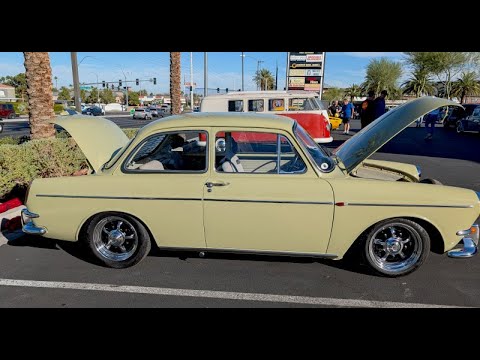
There is a particular pleasure in a car that knows what it is. The 1964 Type 3 Fastback was not confused about its identity. It was a practical, rear-engined, air-cooled Volkswagen with a fastback roofline and more luggage space than seemed geometrically possible. It was not trying to be a sports car. It was not embarrassed about being a family car. It was, in the truest sense, exactly itself.
The air-cooled flat-four that powered the 1964 Fastback (Type 3). Simple, reliable, and endlessly modifiable.
1493cc (1.493L) Air-cooled 'pancake' flat-4
45 HP
Type 3
2-door sedan
4-speed manual
Counterculture forming.
All specifications should be verified before publication.
Refer to the specifications section above for the engine code used in the 1964 Type 3. The engine code is typically stamped on the engine case above the generator. For verification assistance, use our M-Code decoder tool.
Confidence: medium — This information should be verified with additional sources.
The value of a 1964 Type 3 varies significantly based on condition, originality, and documentation. Driver-quality examples typically range from lower values, while excellent restored or numbers-matching examples command premiums. Condition, originality, and documentation are the primary value drivers. Always get a professional appraisal for insurance or sale purposes.
Confidence: low — This information requires verification before use.
1964 Type 3 models were produced at various Volkswagen factories worldwide. Check the production details above for specific factory information. The factory code can often be identified through chassis number analysis.
Confidence: medium — This information should be verified with additional sources.
The 1964 Type 3 received several updates from the 1963 model. Refer to the specifications and editorial sections above for detailed information about year-to-year changes. Changes may include mechanical updates, safety features, or cosmetic refinements.
Confidence: medium — This information should be verified with additional sources.
Common rust areas on air-cooled Volkswagens include heater channels (under running boards), floor pans (especially front and battery tray area), front beam (suspension mounting point), rear chassis/apron (where bumper mounts), and door bottoms. The heater channels are structural and expensive to repair. Always inspect these areas carefully before purchase.
The 1965 Type 3 received updates from the 1964 model. Check the specifications section above for details about year-to-year evolution. Common changes across model years include safety updates, mechanical refinements, and regulatory compliance features.
Confidence: medium — This information should be verified with additional sources.
A full rotisserie restoration typically costs $25,000-$50,000+ depending on condition and level of finish. Mechanical refresh (engine, brakes, suspension) runs $5,000-$12,000. Bodywork and paint alone can be $8,000-$15,000 for quality work. DIY restorations save labor but require significant time investment (500-1,000 hours). Parts availability is generally good for classic VWs, which helps control costs.
Confidence: low — This information requires verification before use.
A well-maintained 1964 Type 3 can serve as a daily driver, but consider the age of the vehicle. Modern traffic, safety features, and reliability expectations differ from the era. Regular maintenance, mechanical knowledge, and realistic expectations are essential. Many owners use classic VWs as weekend drivers or hobby vehicles rather than primary transportation.
Confidence: medium — This information should be verified with additional sources.
Yes, parts availability for classic air-cooled Volkswagens is generally excellent. The large enthusiast community and aftermarket support mean most mechanical and body parts are readily available. Some year-specific trim pieces or rare options may be harder to find, but the core mechanical components are well-supported.
Research current market values for the 1964 Fastback (Type 3)
Hagerty Valuation Tools
Industry-standard classic car values
Bring a Trailer Results
Recent auction prices
TheSamba Classifieds
Current listings & asking prices
Buying tip: Condition is everything. A rusty "project" can cost more to restore than buying a finished car. Check heater channels, floor pans, and battery tray first.
Original paint options available for the 1964 Fastback (Type 3).
Looking for a 1964 Fastback (Type 3) in Black?
Find for SaleExplore the variants available for this model year and find your perfect match.
Want to see a detailed comparison of multiple vehicles?
Compare all variantsNumbers matching verification increases value by 20-40%. Use our tools to verify engine codes, chassis numbers, and M-codes for your 1964 Fastback (Type 3).
There is a particular pleasure in a car that knows what it is. The 1964 Type 3 Fastback was not confused about its identity. It was a practical, rear-engined, air-cooled Volkswagen with a fastback roofline and more luggage space than seemed geometrically possible. It was not trying to be a sports car. It was not embarrassed about being a family car. It was, in the truest sense, exactly itself.
The 1964 model year saw the Type 3 range transitioning from 1200cc to 1500cc power — the larger engine was available in certain configurations, and the Fastback body continued its refinement. VW was entering its great American decade, and the Type 3 was the sophisticated cousin to the Beetle's folk hero.
The 1964 Fastback used the Type 3 1200/1500 engine family — the pancake flat-four that enabled the Fastback's defining design feature. In 1200cc form, 54 horsepower. In 1500cc form, 45 horsepower but with more torque and longer-legged delivery. The four-speed manual was standard. Left- and right-hand drive configurations served European markets broadly.
The body was the 1963 design carried forward with incremental refinement: better-fitting trim, slightly improved interior detailing, the same clean fastback line from roof peak to tail. Interior colors ran to the period's preference for dark, practical tones — black, dark gray, medium gray. The car was honest about what it was and dressed accordingly.
The transition to 1500cc power in 1964 represented a genuine improvement in the Type 3's usability without any compromise to its character. More torque at lower revs made city driving more relaxed; slightly better highway pace removed one of the 1200's few limitations. VW's engineering teams were, characteristically, solving problems the customer hadn't quite articulated yet.
The Fastback body's packaging continued to impress. Front storage, rear luggage access through the hatch, four proper seats, and a shape that suggested a car with more sporting intent than its specification sheet confirmed — it was a design that worked harder than it looked.
In 1964, the Tokyo Olympics brought the world to Japan and the Japanese bullet train demonstrated that engineering ambition could shape the future. America sent its first Ford Mustang to market in April, creating pony car fever. Europe continued its careful integration, economic and otherwise.
Against the Mustang's exuberance, the Type 3 Fastback looked reserved to the point of severity. But it was making a different argument entirely: not about power or theater, but about precision, efficiency, and the quiet pleasure of a car that did exactly what was asked of it, year after year, without drama.
With the 1500cc engine, the 1964 Fastback was a noticeably more capable car than its immediate predecessor. The extra displacement filled in the torque curve, making second-gear city maneuvers more relaxed and third-gear overtaking less of a negotiation. The four-speed manual's ratios were well suited to the new power delivery.
The chassis was unchanged and remained the Type 3's secret strength: torsion bars fore and aft, a swing axle at the rear that required awareness rather than fear, responsive and direct steering. On the winding roads of Bavaria or the Ardennes, the Fastback's fastback balance — most weight over the rear wheels — became an asset rather than a liability.
The 1964 Fastback found its buyers among the European middle class: people who had perhaps started with a Beetle and upgraded, or who wanted something more stylish than the Squareback without wanting something impractical. The fastback body attracted buyers with a slightly more expressive sensibility — people who preferred the coupe proportions and didn't mind if the luggage space was slightly smaller than the Squareback's.
In design and architecture circles it had its devotees. The car's Teutonic restraint, its purposeful proportions, its refusal to follow fashion — these were qualities that resonated with people who thought seriously about form.
The 1964 Type 3 Fastback is a rare car in genuinely good condition. Bodies of this vintage have had sixty years to rust, and the Type 3 accommodated that process willingly. The floors, sills, and battery tray area are the first concerns; the rear lower quarters follow.
A 1200cc car is period-correct but increasingly difficult to maintain at the engine level; a 1500cc example from this transitional year is more practical. Either way, buy for body quality. The Type 3 community has resources, registers, and specialists across Europe and North America. Getting connected before buying is the single best investment of time you can make.
The 1964 Type 3 Fastback occupies the inflection point of the model's development: past the early uncertainty, not yet at the final refinement, doing everything right at the right moment.
It is a car of considered pleasures. Those who seek them will find them entirely intact.