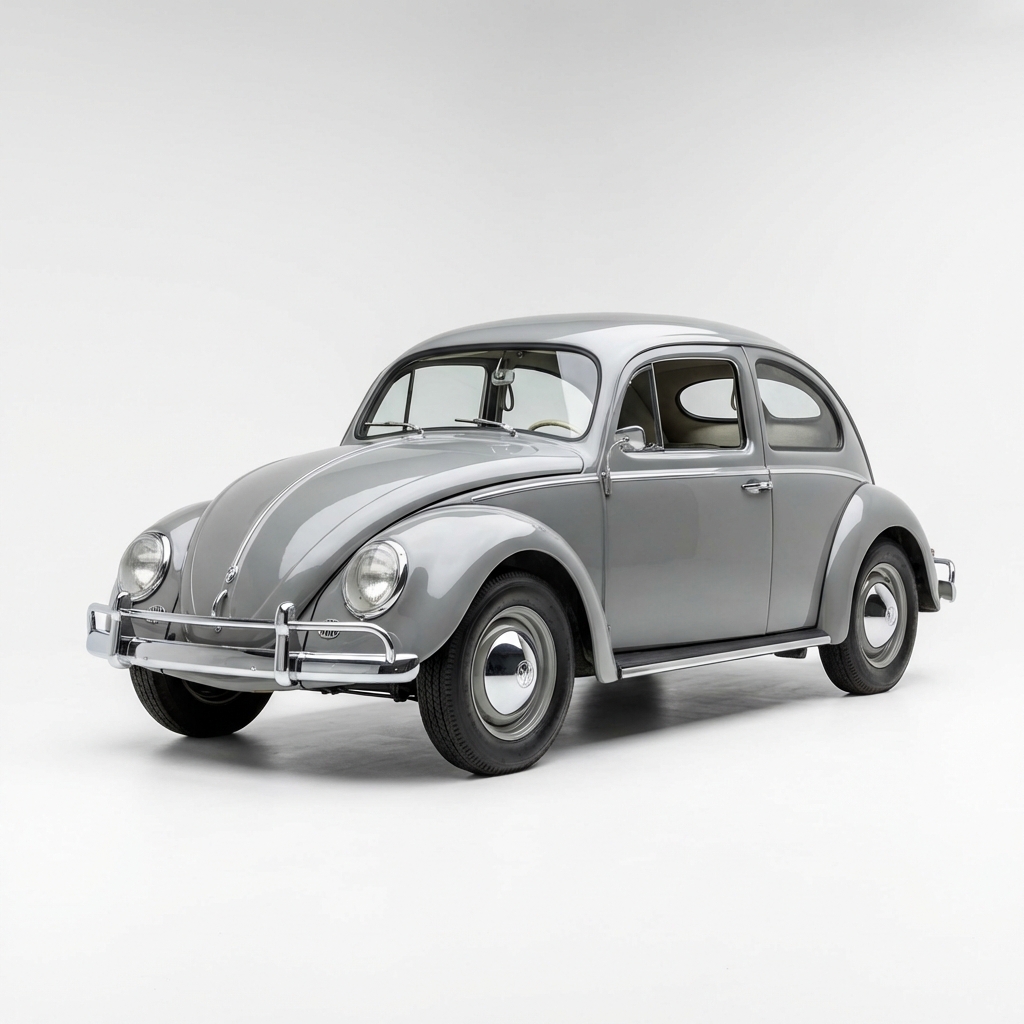
2-door sedan

1949 Beetle

1131cc
Displacement
25HP
Power
N/A
Top Speed

Real Stories

1949 VW Split Window Beetle - German Border Patrol
11:49

1949 Type 1 Beetle: When Germany Built Truth Instead of Cars

Discover the 1949 VW Beetle: 25 horsepower of post-war honesty, split-window simplicity, and accidental revolution. When necessity created automotive philosophy.

1949: Europe in ruins, America booming, Germany divided. While Detroit prepared chrome dreams and V8 fantasies for the coming decade, Heinrich Nordhoff stood in a bomb-damaged Wolfsburg factory and made the most radical decision in automotive history: build honesty instead of cars.

The first Export Beetles trickled into America—25 horsepower of German engineering, split rear windows, and zero pretense. Detroit laughed. History wasn't listening. The Beetle arrived not as revolution but as necessity: no chrome because materials were scarce, no power because efficiency meant survival, no styling changes because consistency meant quality.

Nordhoff didn't know he was creating philosophy. He was just building cars with whatever post-war Germany had left. Accidentally perfect timing.

Read the Full Story

Engineering.

The air-cooled flat-four that powered the 1949 Beetle. Simple, reliable, and endlessly modifiable.

1131cc

Air-cooled flat-4

The air-cooled flat-four engine that powered a generation. Code Type 1 engine.

Power
25 HP
Fuel
Carburetor

Highlights.

Feature

Featured

air-cool

Feature

Feature 2

The 1949 Beetle wasn't special because of what it had—it was special because of what it lacked.

Engine

Engine Size

1131cc (1.131L) Air-cooled flat-4

Engine

Horsepower

25 HP

Quick Facts — 1949 Beetle

  • Engine SizeNeeds Review

    1131cc (1.131L) Air-cooled flat-4

  • HorsepowerNeeds Review

    25 HP

  • Engine CodeNeeds Review

    Type 1 engine

  • Body StyleNeeds Review

    2-door sedan

  • TransmissionNeeds Review

    4-speed manual (non-synchronized)

  • Current Market ValueNeeds Review

    Project: $25,000.

    Values from editorial 'Today' section, market conditions vary

  • Cultural SignificanceNeeds Review

    1949 America was entering its golden age: suburbs expanding, V8s rumbling, chrome gleaming, optimism infinite.

  • Restoration Cost EstimateNeeds Review

    engine rebuild: $,

    Costs vary dramatically by region and quality expectations

All specifications should be verified before publication.

Top Questions — 1949 Beetle

Refer to the specifications section above for the engine code used in the 1949 Beetle. The engine code is typically stamped on the engine case above the generator. For verification assistance, use our M-Code decoder tool.

Confidence: medium — This information should be verified with additional sources.

A 1949 Beetle's value ranges from $25,000 for project cars. Condition, originality, and documentation are the primary value drivers. Always get a professional appraisal for insurance or sale purposes.

Confidence: medium — This information should be verified with additional sources.

Sources

  • VWX Reference: VWX Editorial - 1949 Beetle Today section

1949 Beetle models were produced at various Volkswagen factories worldwide. Check the production details above for specific factory information. The factory code can often be identified through chassis number analysis.

Confidence: medium — This information should be verified with additional sources.

Common rust areas on air-cooled Volkswagens include heater channels (under running boards), floor pans (especially front and battery tray area), front beam (suspension mounting point), rear chassis/apron (where bumper mounts), and door bottoms. The heater channels are structural and expensive to repair. Always inspect these areas carefully before purchase.

The 1950 Beetle received updates from the 1949 model. Check the specifications section above for details about year-to-year evolution. Common changes across model years include safety updates, mechanical refinements, and regulatory compliance features.

Confidence: medium — This information should be verified with additional sources.

A full rotisserie restoration typically costs $25,000-$50,000+ depending on condition and level of finish. Mechanical refresh (engine, brakes, suspension) runs $5,000-$12,000. Bodywork and paint alone can be $8,000-$15,000 for quality work. DIY restorations save labor but require significant time investment (500-1,000 hours). Parts availability is generally good for classic VWs, which helps control costs.

Confidence: low — This information requires verification before use.

Numbers matching (original engine, transmission, and chassis) typically increases value by 20-40% over non-matching examples. However, the premium varies based on overall condition, documentation, and market demand. Use our numbers matching verification tool to check your vehicle.

Confidence: medium — This information should be verified with additional sources.

A well-maintained 1949 Beetle can serve as a daily driver, but consider the age of the vehicle. Modern traffic, safety features, and reliability expectations differ from the era. Regular maintenance, mechanical knowledge, and realistic expectations are essential. Many owners use classic VWs as weekend drivers or hobby vehicles rather than primary transportation.

Confidence: medium — This information should be verified with additional sources.

Yes, parts availability for classic air-cooled Volkswagens is generally excellent. The large enthusiast community and aftermarket support mean most mechanical and body parts are readily available. Some year-specific trim pieces or rare options may be harder to find, but the core mechanical components are well-supported.

Why This Year Matters

Needs Review
  • Featured: air-cool
  • The 1949 Beetle wasn't special because of what it had—it was special because of what it lacked.
Collector AppealMedium
Restoration ComplexityMedium
Daily Driver SuitabilityMedium

Valuation Resources

Research current market values for the 1949 Beetle

Buying tip: Condition is everything. A rusty "project" can cost more to restore than buying a finished car. Check heater channels, floor pans, and battery tray first.

Black

L41solidcommon

Factory Colors

Original paint options available for the 1949 Beetle.

solid Colors

Looking for a 1949 Beetle in Black?

Find for Sale

Which 1949 Beetle fits your style?

Explore the variants available for this model year and find your perfect match.

Want to see a detailed comparison of multiple vehicles?

Compare all variants

Verify Authenticity

Numbers matching verification increases value by 20-40%. Use our tools to verify engine codes, chassis numbers, and M-codes for your 1949 Beetle.

Correct Engine CodeType 1 engine

The Full Story

Introduction

1949: Europe in ruins, America booming, Germany divided. While Detroit prepared chrome dreams and V8 fantasies for the coming decade, Heinrich Nordhoff stood in a bomb-damaged Wolfsburg factory and made the most radical decision in automotive history: build honesty instead of cars.

The first Export Beetles trickled into America—25 horsepower of German engineering, split rear windows, and zero pretense. Detroit laughed. History wasn't listening. The Beetle arrived not as revolution but as necessity: no chrome because materials were scarce, no power because efficiency meant survival, no styling changes because consistency meant quality.

Nordhoff didn't know he was creating philosophy. He was just building cars with whatever post-war Germany had left. Accidentally perfect timing.

What It Was

The 1949 Beetle was automotive haiku: nothing wasted, nothing extra, everything necessary. Factory specs read like a minimalist manifesto:

  • Engine: 1131cc flat-four, 25 heroic horsepower
  • Transmission: 4-speed manual, no synchromesh (grinding gears was analog music)
  • Body: Split rear window because one big curve was too expensive
  • Suspension: Independent all around (sophistication born of necessity)
  • Brakes: Cable-operated mechanical (hydraulics were a 1950 luxury)
  • Electrical: 6-volt system, semaphore turn signals (arms that waved goodbye to complexity)

Two variants existed: Standard (austere) and Export Deluxe (austere with chrome). Both proved that poverty creates better engineering than prosperity. When you can't add features, you perfect fundamentals.

What Made It Special

The 1949 Beetle wasn't special because of what it had—it was special because of what it lacked. No radiator to leak. No water pump to fail. No coolant to freeze. No chrome to rust. No promises it couldn't keep.

The air-cooled engine wasn't innovative—it was survival equipment for a country with broken infrastructure. The rear-engine layout wasn't radical engineering—it was practical necessity for traction on damaged roads. The split rear window wasn't design—it was manufacturing pragmatism.

Every 'limitation' became strength. Cable brakes needed adjustment but never failed catastrophically. Non-synchro transmission taught mechanical sympathy. Six-volt electrics meant fewer components to short out. The heater barely worked, but that meant fewer parts to break.

Nordhoff's genius wasn't engineering—it was honesty. He built a car that reflected post-war reality: simple, durable, fixable. Detroit built dreams. Wolfsburg built truth.

Cultural Context

1949 America was entering its golden age: suburbs expanding, V8s rumbling, chrome gleaming, optimism infinite. The average American car had 100+ horsepower, annual styling changes, and planned obsolescence as corporate strategy. Detroit wasn't selling transportation—it was selling the American Dream, chrome-plated and payments optional.

Meanwhile, Germany was rubble. The Berlin Airlift had just ended. The country was divided, occupied, humbled. 'Made in Germany' still carried war stigma. The Beetle arrived into this context like a documentary at a movie premiere—simple truth among technicolor fantasies.

The few Americans who bought 1949 Beetles weren't making statements—they were making decisions. European immigrants who remembered German engineering. Pragmatists who valued function over flash. Early adopters who recognized that post-war necessity had created accidental excellence.

Detroit saw 25 horsepower and laughed. They missed the point: the Beetle wasn't competing with American cars. It was competing with American assumptions about what cars should be.

How It Drove

Driving a 1949 Beetle was like using a manual typewriter—everything required intention, nothing happened by accident. The non-synchro transmission demanded mechanical sympathy or sacrificial gears. The cable brakes needed a firm push and regular adjustment. The steering was direct, unassisted, honest.

Zero to 60? Eventually. Top speed? When conditions permitted. The 25-horsepower engine wasn't built for performance—it was built for survival. It would run in Siberian winter or Saharan summer because air cooling doesn't care about conditions.

Today, driving a '49 Beetle is time travel. Every control is mechanical. Every response is direct. The split rear window divides your rear view like a Mondrian painting. The semaphore turn signals pop out like tiny surrendering arms. Modern cars isolate you from the experience of motion. The '49 Beetle makes you its co-conspirator.

Who Bought It

1949 Beetle buyers came in three flavors:

  1. European Immigrants: They remembered German engineering from before the war. They understood that necessity creates better solutions than prosperity.

  2. Practical Revolutionaries: Intellectuals, engineers, architects who recognized the Beetle's honesty as antidote to Detroit's excess. They weren't buying transportation—they were buying philosophy.

  3. Economic Pragmatists: The Beetle cost less, used less fuel, needed less maintenance. They bought logic instead of chrome.

What united them? Understanding that limitations create character. The Beetle's weaknesses were honest. Its strengths were earned. In 1949, that wasn't marketing—it was survival. These buyers weren't early adopters—they were truth seekers.

Evolution

The 1949 Beetle wasn't the beginning—it was the foundation. Everything VW built for the next 30 years evolved from this moment of post-war clarity:

  • Split rear window (1949-1953): Two small panes because one large curve was too expensive
  • Cable brakes (1949 only): Replaced by hydraulics in 1950 because even honesty needs updating
  • 25hp 1131cc engine: The first step in three decades of gradual evolution
  • Export model introduction: Chrome trim and better finishing for international markets

Production was modest—perhaps 10,000 cars total. Survivors are rare. Most stayed in Europe. The few that reached America through Max Hoffman's New York dealership were automotive missionaries: converting skeptics through reliability rather than rhetoric.

Today

Finding a genuine 1949 Beetle is like finding automotive truth: rare and expensive. Market values in 2025:

  • Museum-Grade: $125,000+ (if you can find one)
  • Restored: $75,000-100,000 (authenticity matters)
  • Project Cars: $25,000+ (mostly in Europe)

Why so valuable? Because 1949 represents purity. No compromises for comfort. No changes for marketing. Just engineering elevated to philosophy through necessity.

Investment outlook: Always ascending. These aren't collector cars—they're historical artifacts. Each one preserves the moment when limitation created perfection, when poverty built better engineering than prosperity, when honesty became strategy by accident.

Restoration

Restoring a 1949 Beetle is like translating ancient text—every detail matters, every shortcut shows, authenticity is everything. Critical points:

Body & Structure:

  • Split windows must be original or German-made reproductions
  • Body panels are hand-made or unobtainable
  • Semaphore turn signals are aerospace-grade unobtanium

Mechanical:

  • Cable brakes require expertise few still have
  • Non-synchro transmission rebuilds are black magic
  • Engine parts exist but authenticity costs extra

Authenticity Rules:

  • Paint must be period-correct (mostly grays, blacks, dark greens)
  • Interior materials must match German production
  • Every deviation must be documented

Advice: Buy the best example you can find. These aren't restoration projects—they're preservation challenges. Time machines require temporal accuracy.

The Bottom Line

The 1949 Beetle wasn't a car—it was a moment when necessity created perfection. Twenty-five horsepower of post-war truth, split rear windows divided by pragmatism, engineering elevated to philosophy through poverty.

Who should buy one?

  • Museums preserving automotive honesty
  • Collectors who value truth over chrome
  • Philosophers who understand that limitation creates character

Who shouldn't?

  • Anyone expecting transportation
  • Restoration optimists
  • Chrome enthusiasts

The 1949 Beetle proves that history's best stories start with honest intentions. Nordhoff didn't set out to create philosophy—he just built the best car post-war Germany could manage. Sometimes poverty builds better solutions than prosperity. Sometimes truth arrives with split rear windows and semaphore turn signals.