1949 Standard Sedan
1131cc25 HP
View Details
Reference review: source-recorded details; historical accuracy has not been comprehensively verified.
1131cc • 25 HP • 2-door sedan
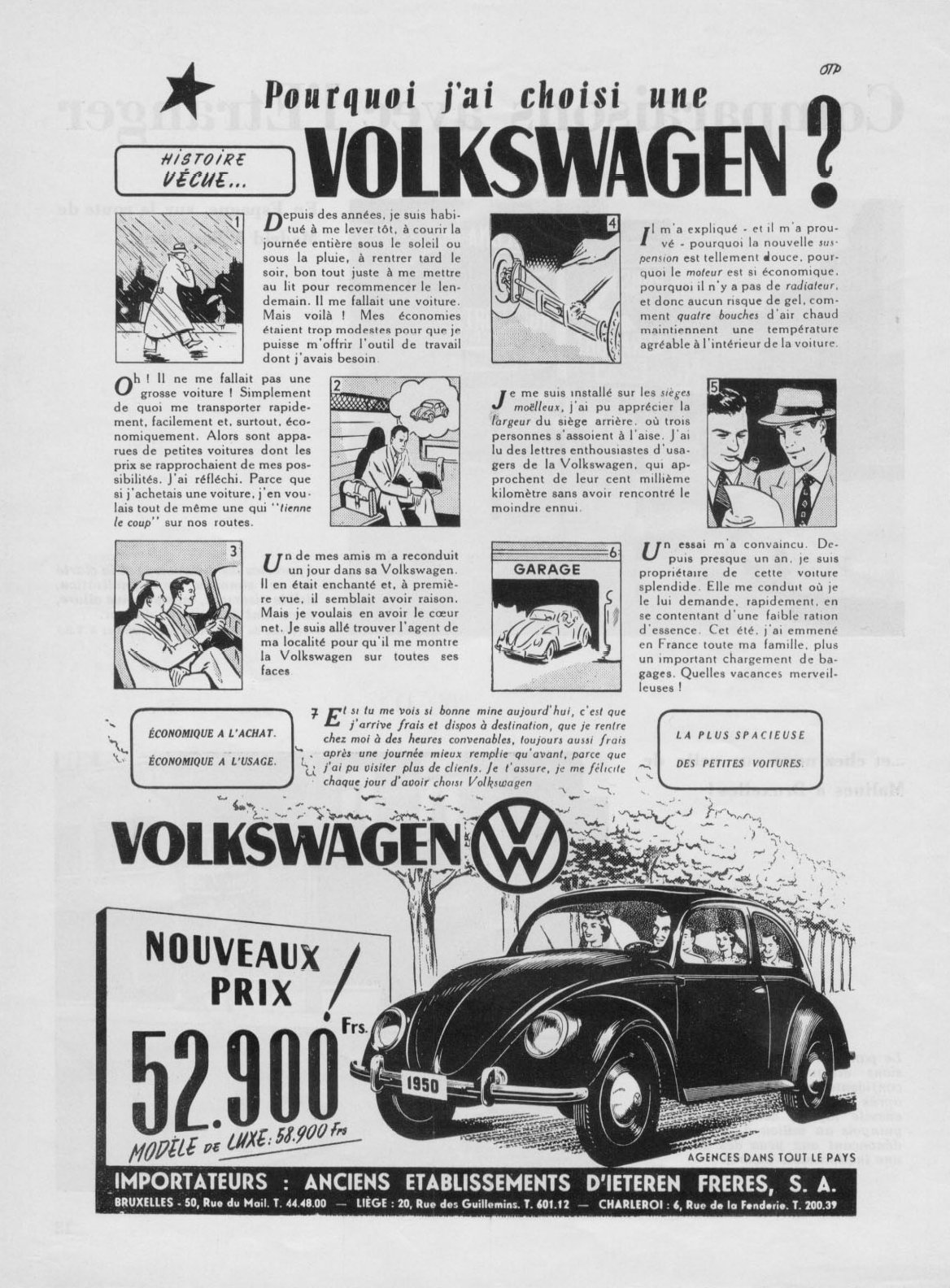
Explore the 1950 VW Beetle: 25hp of pure determination, split rear window, and the audacity to ignore America's chrome addiction. The car that proved simple was smarter.
Representative imagery. Depicted year, configuration and image rights remain unverified.

Featured story
The 1950 Standard Sedan is the only 1950 record with a story on file. Source candidate · under review.
Open the Standard Sedan record950: America discovered credit cards, Charles Schulz launched Peanuts, and Detroit chrome was becoming a national religion. Meanwhile, in a factory built from war's rubble, Volkswagen kept building the least American car possible: 25 horsepower of pure German pragmatism wrapped in a shape that looked like an engineering equation made metal. The 1950 Beetle wasn't just swimming against Detroit's chrome tide—it was questioning whether the tide knew how to swim. Split rear window, semaphore turn signals, cable brakes that required actual skill. This wasn't a car for 1950s America. This was a car for 1950s America to completely misunderstand, then eventually realize was right all along. The ultimate slow-burn revolution: 25 horsepower at a time.
Displacement
Power
From the 1950 Standard Sedan record.
The 1950 Type 1 arrived with specs that read like a declaration of automotive minimalism: 1131cc air-cooled flat-four producing 25 horsepower (yes, twenty-five, that's not a typo). Four-speed manual with non-synchronized first gear because synchronizers were clearly bourgeois excess. Cable-operated brakes because hydraulic fluid is just water showing off. Split rear window because one piece of glass was apparently too Hollywood. Semaphore turn signals that popped out of the B-pillars like tiny surrender flags (except these never surrendered). Body: steel, painted in colors chosen from the 'Various Shades of Pragmatic' palette. Interior: seats, steering wheel, speedometer. Radio: What do you think this is, a Cadillac? The whole package weighed about 1,600 pounds—roughly the weight of one American car's chrome bumper. Wheelbase: 94.5 inches. Length: 160 inches. Purpose: prove that intelligence beats excess.
The 1950 Beetle wasn't special because of what it had—it was special because of what it refused to have. No radiator, because air-cooling was simpler. No power anything, because arms and legs came standard. No chrome jewelry, because honesty doesn't need accessories. The split rear window wasn't a style choice—it was engineering pragmatism cast in glass. Two smaller panes were easier to manufacture and replace than one large one. The torsion bar suspension wasn't revolutionary—it was just smarter than springs. Every 'missing' feature was actually a present intelligence. The cable brakes required skill to operate well—they made you a better driver by requiring you to be one. The non-synchronized first gear taught mechanical sympathy whether you wanted to learn it or not. Even the 25 horsepower wasn't a limitation—it was a lesson in momentum management. This wasn't a car that gave you everything. It was a car that made you earn everything. And that made all the difference.
From the 1950 Standard Sedan record.
1950 America was drunk on optimism and chrome. The war was won, suburbs were sprouting, and Detroit was converting victory into sheet metal excess. The Buick Roadmaster stretched 18 feet and weighed two tons—a rolling testament to the idea that bigger meant better. Tail fins were emerging like automotive delusions of grandeur. Drive-ins were replacing restaurants because why walk when you have a two-ton chrome chariot? The Korean War started in June, but America was too busy buying refrigerators to notice. The first credit cards appeared, because paying for things immediately was apparently for communists. Charles Schulz launched Peanuts, proving that even minimalist art could capture America's imagination. If only they'd applied that same appreciation to minimalist cars. Into this chrome-plated optimism rolled the Beetle, looking like a philosophical argument on wheels. It wasn't just counter-cultural—it was counter-everything. Small when America wanted big. Slow when America wanted fast. Honest when America wanted chrome. It was so wrong for 1950 America that it was actually right—they just wouldn't realize it for another decade.
Driving a 1950 Beetle was less about acceleration and more about the Zen art of momentum maintenance. Zero to 60? Yes, eventually. Top speed was theoretical—you focused on the practical art of keeping your current speed. The non-synchronized first gear turned every start into a mechanical mindfulness exercise. Double-clutching wasn't a technique—it was a meditation. The cable brakes required planning, anticipation, and a healthy respect for physics. Modern drivers in restored '50 Beetles discover what original owners knew: this isn't a car you merely operate—it's a car you learn to dance with. The steering is direct, unassisted, honest. The suspension—torsion bars front and rear—delivers surprising suppleness. The 25 horsepower feels like... exactly 25 horsepower. But here's the magic: it's enough. Not for drag races or ego contests, but for the actual task of moving through space with intelligence and purpose. It's transportation distilled to its essence.
The 1950 Beetle's American buyers fell into three camps: European immigrants who understood engineering value, pragmatists who did the math on Detroit's running costs, and people who were either brave or crazy depending on who you asked. This wasn't impulse-buy transportation. You didn't buy a '50 Beetle because the neighbors would envy it (unless your neighbors were German engineers). You bought it because you did the math, studied the engineering, and concluded that America's chrome addiction might be unsustainable. The typical buyer was more likely to own a slide rule than a golf club membership. They were the early adopters of automotive intelligence—the ones who figured out that 25 honest horsepower beats 150 dishonest ones. They were either visionaries or lunatics. History proved them visionaries. Detroit eventually proved them right.
The 1950 Beetle wasn't just a car—it was a thesis statement. Everything that followed was just supporting evidence. The split rear window (1949-1953) marked the purest expression of the Beetle's engineering-first philosophy. The 1131cc engine would grow incrementally, but that original 25 horsepower proved that adequacy beats excess. The cable brakes would eventually give way to hydraulics, but not before teaching a generation about mechanical sympathy. The semaphore turn signals would surrender to modern blinkers, but they proved that solving problems doesn't always require complexity. This was Year Two of the Beetle's post-war evolution—the year it proved its philosophy wasn't just surviving, it was spreading. The DNA established in 1950 would replicate through every Beetle until 2003: build it simple, build it strong, let time prove you right.
In 2025, a 1950 Beetle isn't just a classic car—it's automotive philosophy made metal. Values reflect this status: Perfect restorations command $40,000-60,000. Solid drivers: $25,000-35,000. Projects start around $10,000, but beware—split-window parts aren't just rare, they're historical artifacts. That 25-horsepower engine? Original rebuilds cost more than modern performance upgrades. Because authenticity beats velocity. The investment outlook is clear: these aren't just appreciating classics, they're mechanical philosophers. Each surviving 1950 Beetle proves that intelligence outlasts fashion. They're not fast. They're not practical by modern standards. But they're honest in a way that makes modern cars look like they're trying too hard. Buy one because you value truth over torque.
Restoring a 1950 Beetle is like reconstructing a historical argument about automotive philosophy. First challenge: finding one. Real split-window cars are rare. Most 'split-windows' are later cars with modified glass. Authentication matters: check chassis numbers, body stamps, even semaphore holes. The 1131cc engine rebuilds require specialized knowledge—25 horsepower never needed so much expertise. Cable brakes need period-correct components and someone who understands mechanical sympathy. The split window itself? Original glass is unobtainium. Reproductions exist but require expertise to fit. Body panels? Available but expensive. Interior parts? Hope you like treasure hunting. Essential resources: Wolfsburg West for mechanical parts, European specialists for split-window specifics, and a good therapist for when you question your decisions. Budget reality: $50,000-100,000 for a proper restoration. Worth it? If you have to ask, you might not understand what these cars represent.
The 1950 Beetle wasn't just a car—it was a 1,600-pound argument against automotive excess. It had 25 horsepower when Detroit had 150. Split rear window when America wanted panoramic glass. Cable brakes when hydraulics were standard. It was wrong about everything, except it wasn't. It was right too early—a car built on eternal truths in an era addicted to annual changes. Today, it's not just classic—it's prophetic. Who should buy one? People who understand that 25 honest horsepower beats 250 horsepower of marketing. People who appreciate that split rear windows were about engineering, not style. People who know that sometimes, the best way forward is to reject 'forward' entirely. The 1950 Beetle wasn't behind its time. It was ahead of ours.
1,345 words • ~7 min read
Research current market values for the 1950 Beetle
Hagerty Valuation Tools
Industry-standard classic car values
Bring a Trailer Results
Recent auction prices
TheSamba Classifieds
Current listings & asking prices
Buying tip: Condition is everything. A rusty "project" can cost more to restore than buying a finished car. Check heater channels, floor pans, and battery tray first.
Identity under review
This story
Some of this works today. Some of it is still an idea. The chips say which.