Unknown displacement
Air-cooled flat-4
Source-recorded engine code: G.
- Power
- N/A
- Fuel
- Solex 28 PCI carburetor
Reference review: source-recorded details; historical accuracy has not been comprehensively verified.

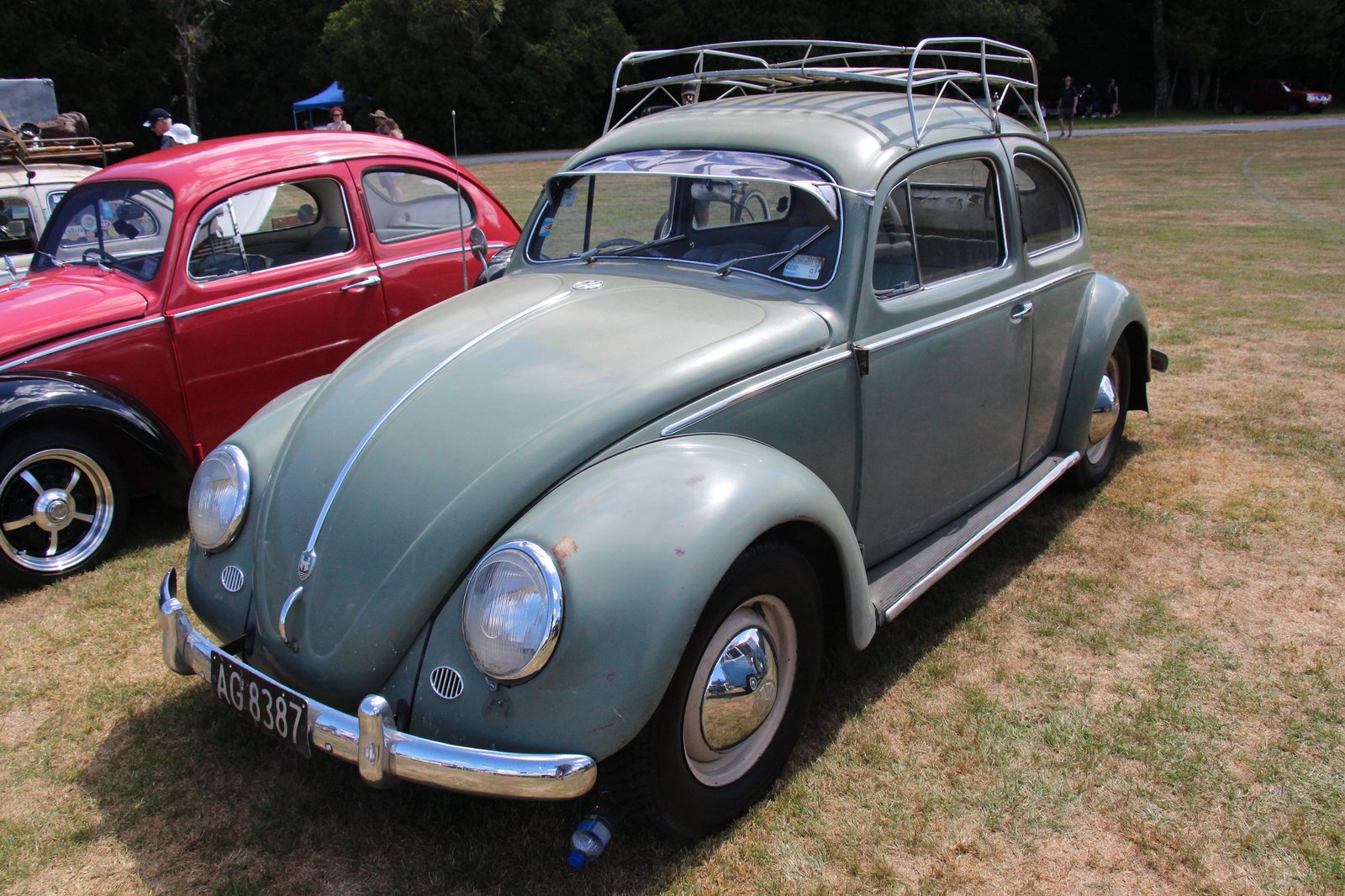
Representative imagery; exact configuration unverified
Explore the 1957 Type 1 Beetle: 36hp of pure conviction, chrome-free philosophy, and the year VW proved less was more. When America went big, VW went honest.
The air-cooled flat-four that powered the 1957 Beetle. Simple, reliable, and endlessly modifiable.
Research current market values for the 1957 Beetle
Hagerty Valuation Tools
Industry-standard classic car values
Bring a Trailer Results
Recent auction prices
TheSamba Classifieds
Current listings & asking prices
Buying tip: Condition is everything. A rusty "project" can cost more to restore than buying a finished car. Check heater channels, floor pans, and battery tray first.
Original paint options available for the 1957 Beetle.
Looking for a 1957 Beetle in Bronze?
Find for SaleContinue from this 1957 reference to other recorded model years and variants.
Want to see a detailed comparison of multiple vehicles?
Compare all variantsUse retained catalog and code references as a starting point for researching your 1957 Beetle. Applicability remains under review; VWX does not authenticate vehicles.
1957: Sputnik orbiting overhead, Elvis gyrating on Ed Sullivan, tail fins reaching for the stars. Detroit was building chrome-laden dreams. VW was building... the same car it had built in 1956. And 1955. And 1954.
The 1957 Type 1 Beetle arrived in an America obsessed with more—more power, more chrome, more everything. VW's response? Thirty-six honest horses, zero chrome, and a shape that hadn't changed since Harry Truman. It wasn't an accident. It was an argument.
While Chevrolet promised 'Sweet, Smooth, and Sassy,' VW offered pragmatic German engineering with all the sassy of a savings account. It worked. The Beetle wasn't just surviving in chrome-plated America—it was thriving. Sometimes, the best way to stand out is to steadfastly refuse to change.
The 1957 Type 1 was automotive minimalism perfected through stubborn repetition:
VW priced it at $1,495—about half of what Detroit charged for entry-level models. You got less car for less money. But what you got worked. Usually.
The standard equipment list was brief enough to fit on a cocktail napkin: windshield wipers (manual), a rear-view mirror, and four wheels. Everything else was optional. Even the radio. Especially the radio.
The 1957 Beetle wasn't special because it changed—it was special because it didn't. While Detroit reinvented itself annually, VW was perfecting the same recipe: rear engine, air cooling, torsion bars, swing axles, and a shape aerodynamic enough to cheat wind but not flashy enough to cheat on its taxes.
The 36-horsepower engine was a masterpiece of deliberate adequacy. It wouldn't win races, but it would run forever. The air-cooling system eliminated the radiator, water pump, and coolant—three fewer things to break. The flat-four design was balanced enough to sound like a sewing machine having an existential crisis.
But the real innovation was VW's anti-innovation stance. In 1957, this wasn't just engineering—it was philosophy. Every unchanged detail was a quiet rebellion against planned obsolescence. The Beetle wasn't just a car; it was a German argument against American excess, delivered at 65 mph (downhill, with a tailwind).
1957 America was drunk on optimism and high-octane gasoline. Eisenhower's Interstate Highway System was under construction. Suburbs were sprouting like chrome-plated mushrooms. Detroit was selling dreams with tail fins attached.
The automotive landscape was surreal: Chevrolet's '57 Bel Air had enough chrome to plate a small battleship. The Plymouth Fury offered 318 cubic inches of V8 excess. Even economy cars were trying to look rich—the Rambler was wearing a tuxedo of trim and two-tone paint.
Into this chrome-plated paradise crawled the Beetle, looking exactly like it had when Hitler was still a current event. It should have failed. It should have been laughed off the newly-paved interstates.
Instead, it found an audience: intellectuals who saw through Detroit's planned obsolescence, pragmatists who valued function over flash, and early adopters of what would become counter-culture. The Beetle wasn't just transportation—it was a statement about consumption, authenticity, and American values. All this from a car that proudly made less power than most lawnmowers.
The timing was perfect: just as Americans were starting to question if bigger was always better, VW was offering an alternative that wasn't just smaller—it was smarter.
In 1957, driving a Beetle was an exercise in patience, planning, and philosophical acceptance. Zero to 60 happened eventually—physics insisted on it. Top speed was theoretical. Hills required strategy. Merging onto highways needed prayer.
But once moving, the Beetle had character. The steering was light and precise. The four-speed gearbox shifted with mechanical honesty. The swing-axle rear suspension added excitement to corners (sometimes too much excitement). The brakes worked (this was considered a feature, not a given, in 1957).
Driving one today is time travel: mechanical, direct, involving. No power steering, no power brakes, no power anything. Just you, 36 horses, and the knowledge that millions of people got where they needed to go with exactly this much car.
The heater still doesn't work. Some things are eternal.
The 1957 Beetle attracted three distinct tribes:
What united them? They all thought they were smarter than Detroit's marketing department. They were right.
The 1957 Beetle represented peak unchanged-ness in VW's relentless pursuit of the same. Evolution since 1948:
This wasn't stagnation—it was refinement. Every unchanged year meant more bugs fixed, more reliability built in. The Beetle wasn't evolving; it was perfecting.
The platform spawned variants (Karmann Ghia, Transporter), but the Beetle remained pure. It was the control group in automotive evolution's grand experiment. While others mutated, it remained steadfast, proving Darwin didn't work in Wolfsburg.
Current market values (2025) for 1957 Beetles reflect their historical significance as peak-unchanged examples:
Investment outlook: Strong. The '57 represents peak mechanical purity before VW started adding... improvements. Originality commands premium. Even projects are climbing.
Buy now if: You appreciate mechanical honesty and don't need to merge onto modern highways. Avoid if: You measure car value in horsepower or cup holders.
Restoring a '57 Beetle is like building a German mechanical watch—simple parts, complex relationships, infinite opportunities for perfectionism:
Common Issues:
Parts Availability:
Restoration Tips:
The 1957 Beetle is automotive zen: the moment before VW started fixing things that weren't broken. It's 36 horsepower of pure conviction, a statement against excess that somehow became excessive in its simplicity.
It's slow by design, reliable by engineering, and charming by accident. It's also the perfect antidote to modern automotive complexity—a car that proves how little you actually need to achieve automotive enlightenment.
Buy it because:
Just don't expect to merge onto highways without planning, heat without patience, or arrive without stories. That's not what it's for. It's for proving that progress isn't always progress, and that sometimes, the best way forward is to stay exactly where you are.