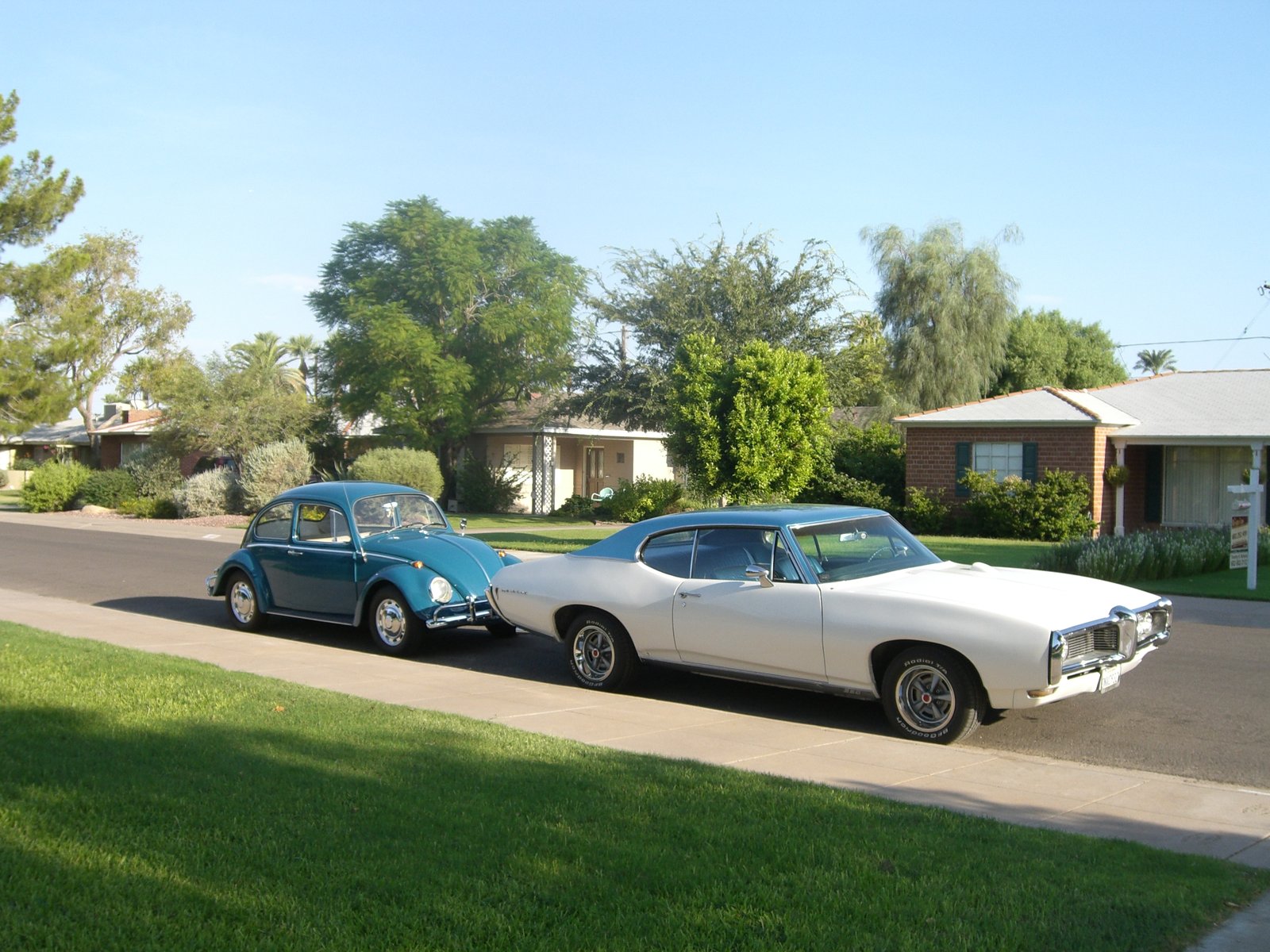
1968 Beetle

1200cc • 40 HP • 2-door convertible

1968 Beetle

Real Stories

1949 VW Split Window Beetle - German Border Patrol
11:49

The Story

he 1968 Volkswagen Beetle is what happens when an engineer asks a radical question: "What if we just... didn't lie?" In an era when Woodstock, moon landing, sexual revolution, civil rights peak, Detroit was selling horsepower fantasies and chrome dreams. The Beetle arrived as proof that you could be honest about what you were—and still be extraordinary.

This wasn't a car trying to impress anyone. It was a car that admired honesty more than flashiness. And that philosophy of radical self-awareness is precisely why it mattered so much in 1968.

Model Information and History

What It Was

That air-cooled flat-four? Not powerful. Genuinely not. Around 40-50 horsepower depending on market. The Beetle wasn't hiding this. The advertising famous admitted it: "Ugly is only skin-deep." "Think Small." "It goes boing." This wasn't false modesty—it was genuine acknowledgment that the point wasn't acceleration, it was arrival.

The torsion bar suspension meant every pothole was a conversation. The manual transmission meant driving was engagement, not automation. The cramped interior meant you were close to the people who mattered. None of these were bugs. They were features celebrated through honest advertising that treated customers like intelligent humans.

In 1968, when Psychedelia, folk-rock, funk emerging, the Beetle's refusal to perform was its most radical statement.

What Made It Special

Here's what made VW different: the advertising didn't hide the truth, it celebrated it. While Detroit sold fantasy, VW sold self-aware reality. "We're not fancy, but we're honest." Not as apology, but as philosophy.

Original owners in 1968 got something deeper than a car. They got permission to stop wanting what they were supposed to want. They got a vehicle that respected their intelligence enough to admit its limitations. That kind of honesty was revolutionary—especially as the culture began questioning what authority was selling them.

For Psychedelia, folk-rock, funk emerging, for the cultural moment happening, the Beetle was the perfect mirror: unpretentious, authentic, deliberately modest.

Cultural Context

Years later, teenagers in the 1980s and 90s would buy these same Beetles at auctions because they still represented something true: you don't need to participate in the lie. You don't need to chase the status symbol. You can just... be honest about what matters.

The Beetle's advertising strategy—admitting weakness as strength—has never aged because it was never trendy to begin with. It was just true.

How It Drove

A 1968 Beetle isn't valuable because it's rare or exotic. Check Hagerty (hagerty.com) for values, but every Beetle owner knows the real treasure: you're preserving a moment when a machine was more honest than its entire culture.

That Beetle represents something increasingly rare: self-aware marketing that respected the customer. Design that admitted its constraints. Engineering that celebrated simplicity. A cultural moment when admitting you weren't trying to be impressive was the most impressive thing you could do.

Do you have a story? Maybe you drove a Beetle and felt permission to be yourself. Maybe you remember when owning one meant something about your values. Maybe you discovered one later and realized Detroit had been lying to you the whole time. Maybe you learned something about authenticity from a car that refused to perform.

The Beetle doesn't judge. It never has. It just keeps running, honestly, with everyone who gets in.

Who Actually Bought One

Nineteen sixty-eight was not a quiet year. Martin Luther King was killed in April. Robert Kennedy in June. Chicago happened in August. Apollo 8 went around the moon in December. And through all of it, someone was buying a 1968 Beetle cabriolet because they needed to drive somewhere and didn't want to think about horsepower. Teachers. Social workers. The second income in a two-income household, spending carefully. The cabriolet's appeal was durability of purpose: it didn't promise transformation. It promised transportation, in the open air, for a reasonable sum. That it also happened to look exactly right was something VW never needed to say out loud.

Buying One Today

The 1968 model year matters to collectors — it's the first year with the external fuel filler, and features improved ventilation and a larger rear window. A well-preserved 1968 cabriolet commands $16,000 to $42,000 depending on condition. The 1200cc engine needs carburetor attention on older restorations. Wiring can be brittle — check the fuse block carefully. Floor pans and battery tray are the rust hot spots. Parts availability for 1968 is excellent; these cars are well-documented and well-supported by the club community. An honest, unrestored driver with original paint is increasingly valuable. The market has figured that out.

The Verdict

The 1968 Beetle cabriolet improved on its predecessors without changing anything you could easily name. A bit more visible out back. Better stopping power up front. Same air-cooled philosophy, same honest slow-car joy, same top-down invitation to pay attention to where you are. By 1968 the Beetle was already a cultural institution, which meant buying one was simultaneously conventional and contrarian. That paradox hasn't aged out. These are cars people keep, restore with care, and drive on days that deserve them. The verdict is what it's always been: smaller than you need, and exactly enough.

823 words • ~5 min read

Reference

Engine

Displacement
1200cc (1.2L)
Configuration
Air-cooled flat-4
Power
40 HP
Engine Code
D, F, E, H, L

Performance

0-60 mph
N/A
Top Speed
N/A
Fuel Economy
N/A

Drivetrain

Transmission
4-speed manual or 3-speed AutoStick semi-automatic
Drive Type
RWD

Chassis

Front Suspension
Torsion bar
Rear Suspension
IRS
Brakes
Drum front and rear
Steering
Worm and roller

Dimensions

Community Resources

Community

Connect with 1968 Beetle owners & experts

Discussions

Soon

Questions, advice, and stories from the community

Photo Gallery

Soon

Owner photos and restoration progress shots

Find a Specialist

Soon

Mechanics and restorers who know this model

Owner Registry

Soon

Connect with other owners near you

Community features coming soon. We're building tools for owners to share knowledge, photos, and connect with specialists. Want early access? Get in touch.

Verify Authenticity

Numbers matching verification increases value by 20-40%. Use our interactive tools to verify engine codes, chassis numbers, and M-codes against production data for your 1968 Beetle.

Correct Engine Code
D, F, E, H, L
Valid Engine Codes
D, F, E, H, L