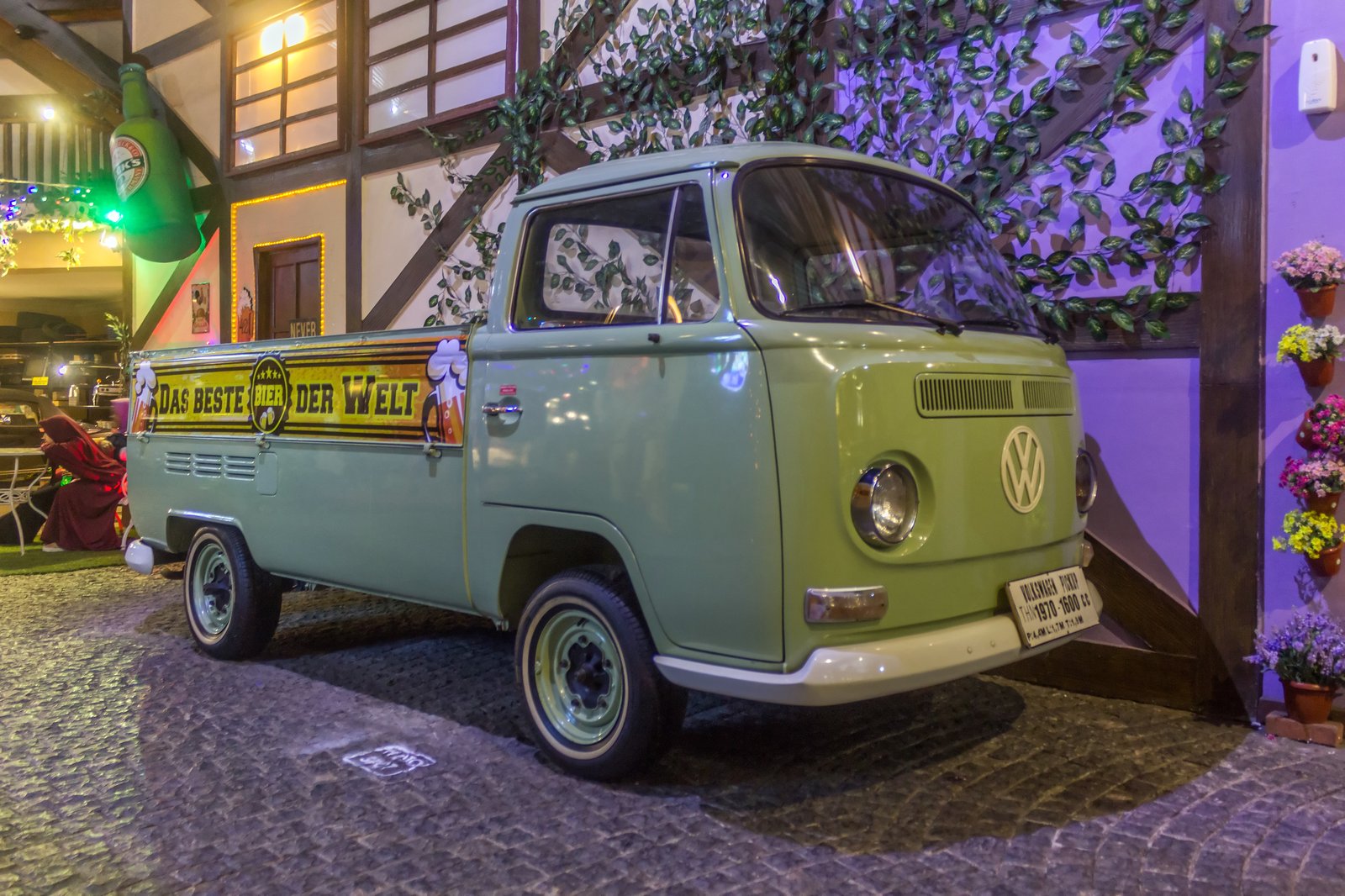
1970 T2 Single Cab (Type 2)
Single Cab Pickup

1970 T2 Single Cab (Type 2)

1584cc
Displacement
57HP
Power
N/A
Top Speed
1970 T2 Single Cab (Type 2) profile

Real Stories

Shaped by Hope: The Story of 'Azul'
The Story of Georgie the VW Bus
1970 T2 Single Cab (Type 2) exterior view

Factory exterior

1 / 1
T2 Single Cab (Type 2)

1970 Single Cab: Work, Upgraded

57 horsepower and a flatbed. In 1970 that was enough. In 2025 it's irreplaceable.

The 1970 Single Cab Pickup received the same power increase as the rest of the T2 lineup: 57 horsepower, up from 47, through the same 1584cc air-cooled engine with improved carburetion. For a working truck that spent its life loaded to capacity, this was not a minor improvement. It was the difference between adequate and competent.

Read the Full Story

Engineering.

The air-cooled flat-four that powered the 1970 T2 Single Cab (Type 2). Simple, reliable, and endlessly modifiable.

1584cc

Air-cooled flat-4

The air-cooled flat-four engine that powered a generation. Code B.

Power
57 HP
Fuel
Carburetor

Highlights.

Feature

Cultural context

counterculture, movement

Feature

Feature 2

The Type 2's boxy, forward-control layout was radical for its time.

Engine

Engine Size

1584cc (1.584L) Air-cooled flat-4 / Type 4

Engine

Horsepower

47 HP

Quick Facts — 1970 Bus

  • Engine SizeNeeds Review

    1584cc (1.584L) Air-cooled flat-4 / Type 4

  • HorsepowerNeeds Review

    47 HP

  • Engine CodeNeeds Review

    B0, AD

  • Body StyleNeeds Review

    Pickup

  • TransmissionNeeds Review

    4-speed manual

  • Cultural SignificanceNeeds Review

    Earth Day 1970 mobilized 20 million Americans for environmental consciousness.

All specifications should be verified before publication.

Top Questions — 1970 Bus

Refer to the specifications section above for the engine code used in the 1970 Bus. The engine code is typically stamped on the engine case above the generator. For verification assistance, use our M-Code decoder tool.

Confidence: medium — This information should be verified with additional sources.

The value of a 1970 Bus varies significantly based on condition, originality, and documentation. Driver-quality examples typically range from lower values, while excellent restored or numbers-matching examples command premiums. Condition, originality, and documentation are the primary value drivers. Always get a professional appraisal for insurance or sale purposes.

Confidence: low — This information requires verification before use.

1970 Bus models were produced at various Volkswagen factories worldwide. Check the production details above for specific factory information. The factory code can often be identified through chassis number analysis.

Confidence: medium — This information should be verified with additional sources.

The 1970 Bus received several updates from the 1969 model. Refer to the specifications and editorial sections above for detailed information about year-to-year changes. Changes may include mechanical updates, safety features, or cosmetic refinements.

Confidence: medium — This information should be verified with additional sources.

Common rust areas on air-cooled Volkswagens include heater channels (under running boards), floor pans (especially front and battery tray area), front beam (suspension mounting point), rear chassis/apron (where bumper mounts), and door bottoms. The heater channels are structural and expensive to repair. Always inspect these areas carefully before purchase.

The 1971 Bus received updates from the 1970 model. Check the specifications section above for details about year-to-year evolution. Common changes across model years include safety updates, mechanical refinements, and regulatory compliance features.

Confidence: medium — This information should be verified with additional sources.

A full rotisserie restoration typically costs $25,000-$50,000+ depending on condition and level of finish. Mechanical refresh (engine, brakes, suspension) runs $5,000-$12,000. Bodywork and paint alone can be $8,000-$15,000 for quality work. DIY restorations save labor but require significant time investment (500-1,000 hours). Parts availability is generally good for classic VWs, which helps control costs.

Confidence: low — This information requires verification before use.

Numbers matching (original engine, transmission, and chassis) typically increases value by 20-40% over non-matching examples. However, the premium varies based on overall condition, documentation, and market demand. Use our numbers matching verification tool to check your vehicle.

Confidence: medium — This information should be verified with additional sources.

A well-maintained 1970 Bus can serve as a daily driver, but consider the age of the vehicle. Modern traffic, safety features, and reliability expectations differ from the era. Regular maintenance, mechanical knowledge, and realistic expectations are essential. Many owners use classic VWs as weekend drivers or hobby vehicles rather than primary transportation.

Confidence: medium — This information should be verified with additional sources.

Yes, parts availability for classic air-cooled Volkswagens is generally excellent. The large enthusiast community and aftermarket support mean most mechanical and body parts are readily available. Some year-specific trim pieces or rare options may be harder to find, but the core mechanical components are well-supported.

Why This Year Matters

Needs Review
  • Cultural context: counterculture, movement
  • The Type 2's boxy, forward-control layout was radical for its time.
Collector AppealMedium
Restoration ComplexityMedium
Daily Driver SuitabilityMedium

Valuation Resources

Research current market values for the 1970 T2 Single Cab (Type 2)

Buying tip: Condition is everything. A rusty "project" can cost more to restore than buying a finished car. Check heater channels, floor pans, and battery tray first.

Black

L41solidcommon

Factory Colors

Original paint options available for the 1970 T2 Single Cab (Type 2).

solid Colors

Looking for a 1970 T2 Single Cab (Type 2) in Black?

Find for Sale

Which 1970 Bus fits your style?

Explore the variants available for this model year and find your perfect match.

Want to see a detailed comparison of multiple vehicles?

Compare all variants

Verify Authenticity

Numbers matching verification increases value by 20-40%. Use our tools to verify engine codes, chassis numbers, and M-codes for your 1970 T2 Single Cab (Type 2).

Correct Engine CodeB

The Full Story

Introduction

The 1970 Single Cab Pickup received the same power increase as the rest of the T2 lineup: 57 horsepower, up from 47, through the same 1584cc air-cooled engine with improved carburetion. For a working truck that spent its life loaded to capacity, this was not a minor improvement. It was the difference between adequate and competent.

The year itself was 1970: Earth Day, Kent State, the Beatles' end. The Single Cab was unaffected by all of it. It had a flatbed to fill and deliveries to make. That was the job. The job didn't change with the news cycle.

What It Was

The 1970 Single Cab was the T2 Pickup in its most essential form: a cab seating three, a flatbed behind, and the most honest engine VW offered. Engine code B, 1584cc, 57 horsepower. Four-speed manual. The same stake-bed configuration with removable wooden side slats. The same payload of around 1,500 pounds.

The physical dimensions were unchanged from 1969. Overall length was compact by American truck standards. The turning radius was tighter than any domestic competitor. The flatbed's accessible all-around load area, combined with the forward-control layout, made it a model of ergonomic efficiency.

The cab was strictly functional: three-across bench seat, large windows, excellent visibility. The dashboard had what it needed and nothing more. This was not a luxury vehicle. This was a tool, built by people who took tools seriously.

What Made It Special

The 1970 power upgrade made the Single Cab more capable without making it more complicated. The same maintenance requirements, the same mechanical simplicity, ten more horsepower. Loaded to capacity on a long grade, this mattered. The '69 had been determined; the '70 was confident.

The combination of payload capacity, compact dimensions, and the new power output made the 1970 Single Cab the most capable-feeling small truck VW had built. Competitors in the light-truck segment — most of them American full-sizes — offered more raw power but less efficiency, less maneuverability, and more cost to operate.

And then there was the design itself, unchanged from the '69 but no less remarkable for that. The forward-control cab perched over the front axle, the flat bed beginning immediately behind, the whole vehicle in perfect proportion. Working trucks that look like design objects are rare. This was one.

Cultural Context

Earth Day 1970 was a recognition that industrial civilization had been treating its infrastructure recklessly. The Single Cab didn't enter that conversation, but it was on the right side of it without trying. Small footprint. Reasonable fuel consumption. Air-cooled engine without coolant waste. A vehicle that did more with less, which was precisely what the first Earth Day was asking for.

In 1970, the American small truck market was still mostly domestic full-sizes. Compact trucks were beginning to arrive — Datsun, Toyota — but the Single Cab's forward-control layout put it in a category by itself. It wasn't competing with Japanese trucks. It was doing something different: proving that a compact truck could be a serious work vehicle without being a scaled-down version of a bigger one.

The contractors and small businesses using Single Cabs in 1970 were largely indifferent to the cultural moment. They had orders to fill and deadlines to meet. The Single Cab met them.

How It Drove

With the '70 power upgrade, the Single Cab loaded to half its payload capacity drove like a vehicle that knew what it was doing. The improved mid-range torque delivery meant less gear-hunting on moderate grades. The four-speed gearbox rewarded the same smooth, deliberate technique as every T2.

Empty, the Single Cab was a different animal — lighter on its feet than you'd expect, responsive in a way that made city driving surprisingly pleasant. The visibility from the cab was exceptional: you could see exactly where your corners were, which made loading and maneuvering in tight spaces less stressful than in any conventional truck.

The character was still VW: deliberate rather than sporty, rewarding smoothness rather than aggression. The Single Cab added a dimension that the Microbus didn't have — the weight in the bed changed the dynamics noticeably, and learning to read the loaded state versus the empty state was part of the experience of ownership.

Who Bought It

The 1970 Single Cab buyer was a small business operator with a specific job to do. Landscapers. Nurseries. Farms with tight access. Urban delivery services. The buyers who chose the Single Cab over a domestic compact weren't making a romantic choice — they were solving a problem. The Single Cab solved it better.

A secondary market had emerged by 1970: the buyer who'd been watching these trucks for a few years and recognized what the Single Cab was. Not just a work vehicle but a resolved design object. The lines were clean, the proportions were right, the function was completely expressed in the form. Some people bought Single Cabs because they were beautiful. They were correct.

European buyers remained steady. In West Germany, the Single Cab was standard agricultural and small-business equipment. In the UK, it was gaining a similar foothold. The vehicle's logic translated across markets because the underlying problem — how to carry both people and things in a compact package — was universal.

Buying Today

The 1970 Single Cab trades at a slight premium over the '69 for buyers who know about the power upgrade, and at the same level for buyers who don't. In either case, the market is strong: driver-quality examples range from $50,000 to $80,000, with exceptional examples exceeding $100,000.

The rust inspection protocol is the same as any T2 Pickup: check the cab corners, the B-pillar, the area under the bed, and the sills. The bed itself — original wooden slats and steel framework — is worth examining carefully. Correct replacement slats are available, but original condition is preferable and valuable.

Given the power upgrade, a 1970 Single Cab is marginally more useful as a driver than the 1969. If you're choosing between years for a vehicle you'll actually use, the '70 is the practical choice. If provenance and originality are the priority, either year is exceptional.

Verdict

The 1970 Single Cab is the working truck that defined what a working truck should be: compact, capable, honest, and somehow beautiful. The power upgrade completed it. The design had always been right; now the engine matched the intent.

In 2025, it's one of the most sought-after classics in the air-cooled world, which would have surprised the landscapers and contractors who were using these as daily work vehicles fifty years ago. They just needed a truck. VW gave them a masterpiece.