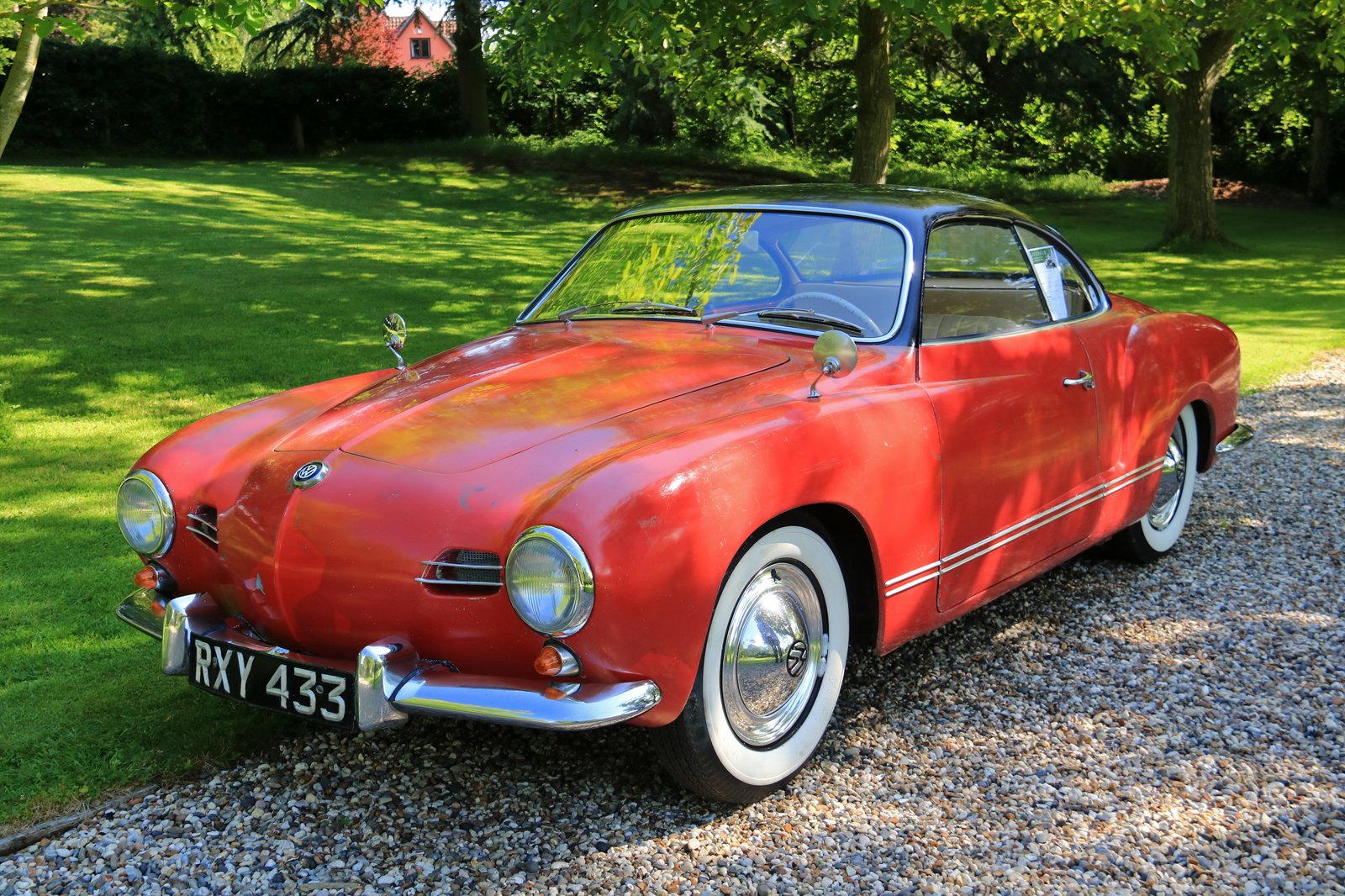
1192cc • 36 HP • 2-door coupe

1955 Type 14 Coupe

The 1955 Karmann Ghia arrived into the noisiest year in American automotive history and stood completely still. No tailfins. No chrome aggression. Thirty-six horsepower and a design that didn't need to prove anything.

Real Stories

VW Karmann Ghia 'lowlight' Debut

Technical Specifications

Engine

Displacement
1192cc (1.192L)
Configuration
Air-cooled flat-4
Power
36 HP
Engine Code
G (Type 1 engine)

Performance

0-60 mph
N/A
Top Speed
N/A
Fuel Economy
N/A

Drivetrain

Transmission
4-speed manual
Drive Type
LHD/RHD available

Chassis

Front Suspension
Torsion bar
Rear Suspension
Swing axle
Brakes
Drum front and rear
Steering
Worm and roller

Dimensions

Factory Colors

Black
L41
Pearl Grey
L21
Horizon Blue
L331

Verify Authenticity

Numbers matching verification increases value by 20-40%. Use our interactive tools to verify engine codes, chassis numbers, and M-codes against production data for your 1955 Type 14 Coupe.

Correct Engine Code
G (Type 1 engine)
Valid Engine Codes
G (Type 1 engine)

The Full Story

Swipe to explore the story of the 1955 Type 14 Coupe

Image placeholder

Introduction

When the Karmann Ghia rolled off assembly lines in 1955, post-war optimism was reaching its peak. Elvis Presley was at Sun Records synthesizing rock and roll. Hot rod culture exploded across America. America was building suburbs, buying televisions, discovering that you could be young and rebellious. But quietly, in European workshops, something different was being created. A car that said: you don't need to shout to be heard.

More than sixty years later, that message still resonates. Whether you owned one in 1955 or discovered one in 1985 at a used car lot, this car has always meant something.

It was the first year of real production. The Karmann coachworks in Osnabrück had committed. The tooling was set. The partnership between VW, Ghia, and Karmann had found its purpose. What they made together would run essentially unchanged for two decades.

What It Was

While Detroit was adding chrome and curves, the Karmann Ghia stood still and whispered. Its proportions were restrained. Its materials honest. Its design said: elegance doesn't require aggression. This wasn't just automotive styling — it was philosophy made metal. German engineering precision fused with Italian aesthetic sensibility created something that appealed to people who didn't think of themselves as car people. It was art. It happened to run on a Beetle engine.

The remarkable thing? That philosophy never aged. Thirty years later, when teenagers in 1985 were looking for cars they could actually afford that didn't feel plastic and corporate, they found this. Still elegant. Still different. Still right. The design that challenged American excess in 1955 challenged 1980s consumerism just as effectively.

The coupe body was all Ghia — Luigi Segre's vision of what a small European GT should look like. Low-slung, curved, minimal. The interior matched: clean dashboard, leather steering wheel, seats designed for comfort rather than bolstering. This was a car for people who had opinions about design.

Image placeholder
Image placeholder

What Made It Special

Beneath that elegant body sat Beetle mechanics. A 1,192cc air-cooled flat-four making 36 horsepower. By muscle car standards, laughable. But that was the point. The Karmann Ghia didn't need to roar. It needed to be reliable. It needed to be understood. It needed to be yours.

The torsion bar suspension came straight from the Beetle playbook, proven and dependable. The four-speed manual transmission meant driving was a conversation, not a transaction. Every gear change intentional. Every corner deliberate.

And critically, this simplicity meant that when a teenager in 1985 bought a thirty-year-old Karmann Ghia for a thousand dollars, they could fix it. They could understand it. They could make it their own. That's engineering that transcends eras.

How It Drove

Slide in. The seat sits lower than a Beetle — the roofline is intimate, the dashboard purposeful. The steering wheel, thin and leather-rimmed, falls exactly to hand. There is no unnecessary material between you and the car.

The clutch is light. The gearshift is short and direct. The engine comes alive behind your shoulders with that distinctive air-cooled bark — functional, honest, a little impatient. You develop an understanding with it rather than commanding it.

Visibility is excellent. The greenhouse design means you can see the corners. Parking is intuitive. On longer roads, the car settled into a composed, unhurried rhythm. It wasn't trying to be exciting. It was trying to be good. And good, properly understood, lasts longer than exciting.

Image placeholder
Image placeholder

Cultural Context

1955 was peak American prosperity. Eisenhower's second term, rock and roll exploding into mainstream consciousness, teenage culture emerging as a distinct demographic. Cars had become identity — chrome-laden symbols of success and status. Bigger was better. Faster was better. More was better.

Elvis Presley was redefining music. James Dean was redefining rebellion, and died doing it in September. American automakers were redefining excess — tailfins grew taller, chrome multiplied. The 1955 Chevrolet Bel Air represented the American ideal: power, style, presence.

Into this world arrived the Karmann Ghia: small, understated, powered by 36 horsepower. It was the anti-American car in every way that mattered. And for a specific type of buyer — design-conscious, European-influenced, immune to Detroit's chrome seduction — it was perfect. The Karmann Ghia said: I don't need to prove anything. I know what beauty is.

Who Bought It

The Karmann Ghia became the car of people who understood something fundamental: that elegance matters. That design matters. That how you move through the world says something about who you are.

Original buyers were architects and designers, young professionals with European sensibilities, women who found American cars aggressive and overwrought. These were people who had been to Italy, or wished they had. People who read design magazines and disagreed with Detroit.

Fifty years later, collectors treasure these cars — not primarily for investment potential, but for what they represent. Design purity. Mechanical honesty. A refusal to follow the crowd. A statement made through presence rather than noise.

Image placeholder
Image placeholder

Buying Today

The 1955 Karmann Ghia Coupe entered production at the Karmann coachworks in Osnabrück. Initial production was limited — approximately 4,600 units in the first partial year. Each body was hand-assembled; panels were hand-fitted, gaps carefully maintained.

The Type 14 designation differentiated it from the Type 1 Beetle platform it shared. Mechanically identical beneath, the Karmann Ghia commanded a significant premium over the Beetle. Buyers paid for design, craftsmanship, exclusivity. They got all three.

Today, a solid, unmodified 1955 coupe is a genuine collector piece. Rust hides in the expected places: floor pans, sills, front corners behind the bumper brackets. A body-off restoration is not unusual. Parts for the mechanicals are plentiful through the Beetle supply chain. Check Hagerty for current market values.

The Verdict

The 1955 Karmann Ghia was there at the beginning of something — not just a car model, but a way of thinking about what a car should be. Not a performance machine. Not a status symbol. A designed object that respected the person driving it.

In an era when automotive design had become arms race, this car chose restraint. That choice proved correct. The design barely needed updating for twenty years. That's not stubbornness — that's confidence.

Find one. Restore it properly. Drive it on evenings when you have somewhere to be but aren't in a hurry. You'll understand what 1955 felt like to get right.

Image placeholder
Swipe or use arrow keys to explore

Browse by Year