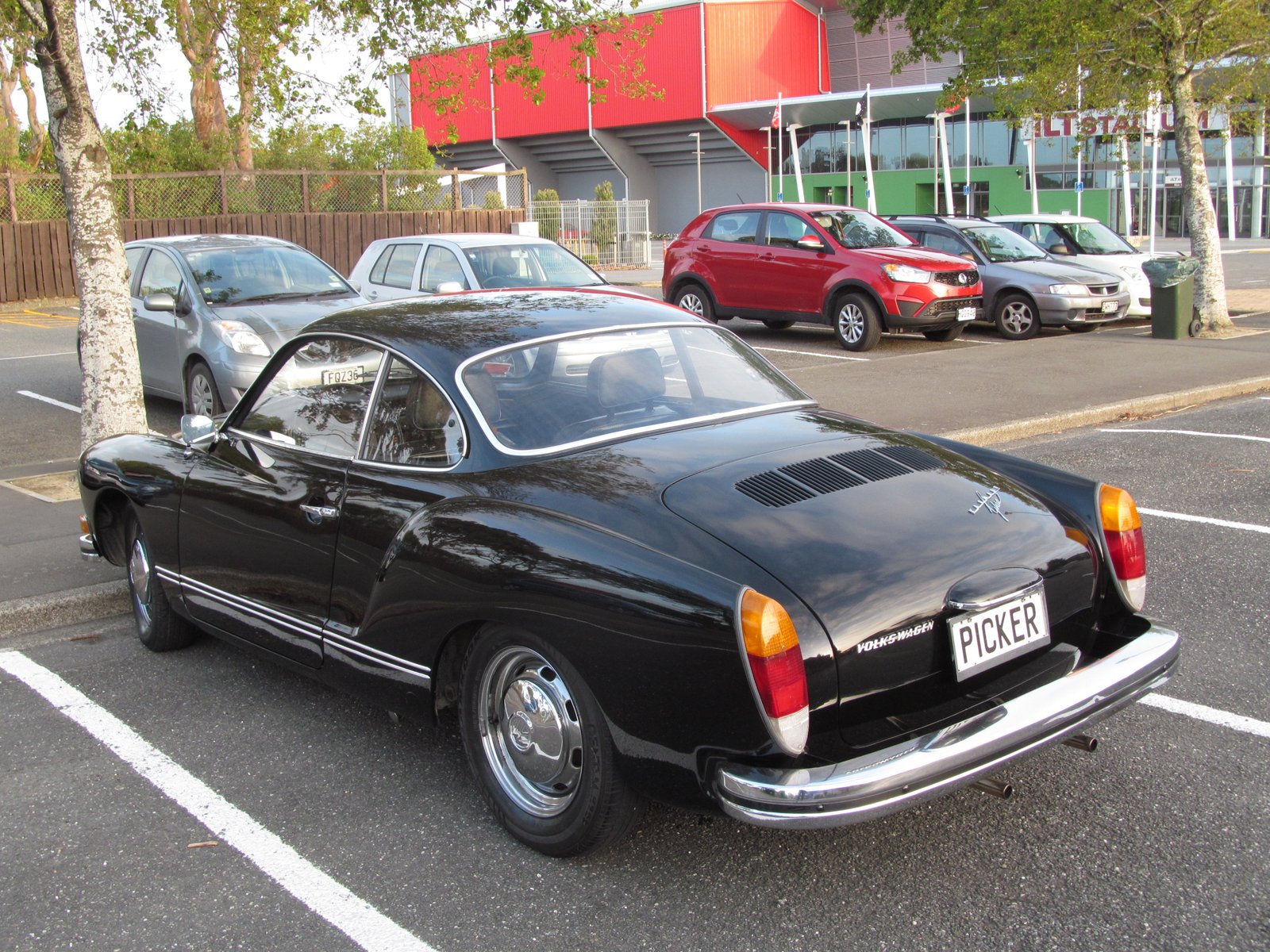
1600cc • 60 HP • 2-door coupe/convertible

1974 Type 14 Coupe

The 1974 Karmann Ghia was the last coupe off the Osnabrück line. Twenty years of refinement, one final model year, and a design that had answered the question of proportion so completely that no one ever felt the need to ask it differently.

Real Stories

VW Karmann Ghia 'lowlight' Debut

Technical Specifications

Engine

Displacement
1600cc (1.6L)
Configuration
Air-cooled flat-4
Power
60 HP
Engine Code
Dual-port 1600

Performance

0-60 mph
N/A
Top Speed
N/A
Fuel Economy
N/A

Drivetrain

Transmission
4-speed manual
Drive Type
LHD/RHD available

Chassis

Front Suspension
Torsion bar
Rear Suspension
IRS
Brakes
Drum front and rear
Steering
Worm and roller

Dimensions

Factory Colors

Sunrise Yellow
L10A
Sunshine Yellow
L13K
Sunset Orange
L20A
Pumpkin Orange
L20B
Burgundy Red
L31A
Paprika Red
L32K
Purple Blue
L51P
Maroon Red
L53H
Kelly Green
L60A
Bronze Green
L61A
Hunter Green
L61H
Brilliant Green
L63H
Aztec Brown
L64K
Ravenna Green
L65K
Cream
L80E
Pastel White
L90D
Cream White
L91Z
Platinum
L95K
Monza Silver Metallic
L96M
Diamond Silver Metallic
L97A
Champagne Gold
L98C

Verify Authenticity

Numbers matching verification increases value by 20-40%. Use our interactive tools to verify engine codes, chassis numbers, and M-codes against production data for your 1974 Type 14 Coupe.

Correct Engine Code
Dual-port 1600
Valid Engine Codes
Dual-port 1600

The Full Story

Swipe to explore the story of the 1974 Type 14 Coupe

Image placeholder

Introduction

The 1974 Karmann Ghia Type 14 represented something historically significant: the final model year before production of the original body design ceased. This wasn't a dramatic redesign or revolutionary reinvention, it was simply the end of a consistent philosophy that had governed the platform since the 1950s. The 1974 model arrived as American embargoes escalated and European oil concerns deepened, at a moment when fundamental questions about automotive strategy were being asked across the industry. The Karmann Ghia, through its simple persistence, offered an answer to those questions.

What It Was

Nearly a quarter-century of continuous production had refined every detail of the Karmann Ghia body to something approaching perfection. The 1974 Coupe embodied this accumulated refinement. Body panels maintained their proportion and presence, curves remained confident and assured, and the overall design felt like a complete statement that required no modification, no improvement, and no apology. The hand-assembly process continued producing bodies of remarkable consistency, and the 1974 model represented the apex of this manufacturing maturity. Looking at a 1974 Coupe, one understands that the design had simply been as good as it could be.

Image placeholder
Image placeholder

What Made It Special

The 1600cc engine had now been proven across more than two decades and tens of millions of vehicles globally. The 4-speed manual transmission was legendary in its simplicity and reliability. The torsion bar suspension had absorbed European roads through decades of evolution and learning. In 1974, this mechanical foundation didn't feel old, it felt proven. The eXperience it offered wasn't cutting-edge, it was fundamental reliability coupled with genuine mechanical engagement. As the automotive industry was beginning to add emissions systems and complexity, the 1974 Karmann Ghia stood as proof that simple mechanics could remain effective.

Cultural Context

1974 meant the oil crisis was in full force, automotive confidence was shaken, and fundamental questions were being asked about the future of the car itself. The Karmann Ghia's answer to these questions was implicit in its continued existence: efficiency, proven reliability, and mechanical honesty transcend crises and trends. The 1974 model represented the final statement of a design philosophy that had proven itself across two decades and countless roads.

For original buyers in 1974, purchasing a final-year Karmann Ghia meant claiming something irreplaceable, an last opportunity to own the original design in its perfected form. For generations discovering these cars later, particularly those drawn to 1970s aesthetic and sustainable simplicity, the 1974 model represented proof that good design could anticipate and survive significant cultural shifts.

Image placeholder
Image placeholder

How It Drove

The 1974 interior maintained the design philosophy that had always guided the Coupe. Materials were functional, controls were logical, and the overall space encouraged active engagement rather than passive consumption. Occupying the 1974 Coupe's interior meant making a deliberate choice about what one valued in an automobile, choosing engagement and simplicity over isolation and complexity. That choice, in the midst of 1970s excess and complication, meant something quite specific.

Who Bought It

The 1974 Karmann Ghia Type 14 holds particular significance as the final year of the original production run. It represents 25 years of refined design, proven manufacturing, and accumulated mechanical knowledge brought to a conclusion at perfect maturity. Collectors specifically seek 1974 examples for their historical positioning and their embodiment of complete design maturity at the moment of completion. The mechanical proven-ness, combined with the historical significance of final-year status, makes 1974 models particularly collectible. Detailed technical documentation, historical information, and current market guidance are available through Hagerty (hagerty.com). What makes 1974 Karmann Ghias increasingly valuable is their position as the final statement of an approach that changed automotive thinking globally.

Image placeholder
Image placeholder

Buying Today

Start under the car, not with the paint. Floor pans on a 1974 Karmann Ghia range from solid to gone, and the difference is the difference between a driver and a restoration. A proper PPI from a VW specialist is not optional on a car of this age and significance.

The 1974 is the final model year, and the market knows it. These cars have appreciated steadily as collectors recognize the historical endpoint. Parts availability remains strong through the VW aftermarket — the mechanical platform is Beetle-derived and well-supported.

Driver quality: $20,000-32,000. Show quality: $42,000-70,000. Coupes represent the more attainable entry point into Karmann Ghia ownership without sacrificing any of the design's essential quality. The final-year premium is real and has widened as collectors pay for historical significance alongside mechanical quality.

The Verdict

The 1974 Karmann Ghia was among the last. Production ended after this model year, closing 20 years of continuous Type 14 production with the same quiet conviction that started it. Production stopped in 1974. Volkswagen had the Golf coming and the future to worry about. They were right about the future. What they couldn't plan for was how much people would miss this specific thing.

Buy it for what it is: a final-year example of something that was never quite reproducible. A sports car that wasn't really a sports car. A luxury car that was genuinely affordable. An Italian design wrapped around German engineering, sold by a company that had already proven it knew how to make people believe in small.

Image placeholder
Swipe or use arrow keys to explore

Browse by Year