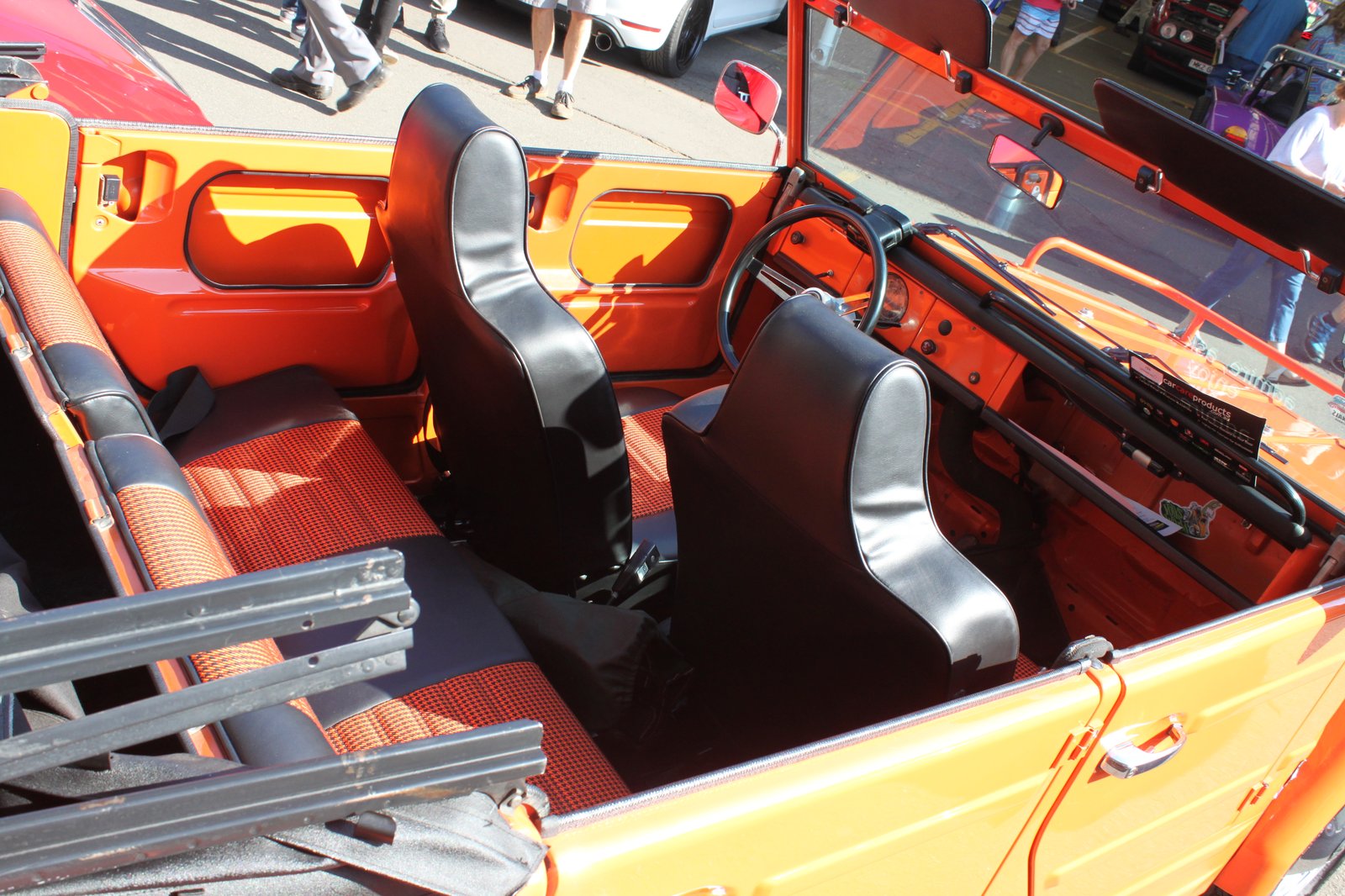
1977 Thing
Convertible utility / Off-road vehicle

1977 Thing

1584cc
Displacement
46HP
Power
N/A
Top Speed
1977 Thing profile

Real Stories

A Birthday in Bali in a VW Thing
1977 Thing exterior view

Factory exterior

1 / 1
Thing

The Go-Anywhere Machine, Still Going

In 1977, cinema invented new worlds and disco ruled the dance floor. The Type 181 continued in production, indifferent to cultural weather, doing what it had always done: going where it was pointed.

The 1977 Volkswagen Type 181 is what happens when German engineers ask one simple question: 'What if we removed everything unnecessary?' The answer is a vehicle so honest, so purely functional, that it becomes remarkable precisely by refusing to be remarkable.

Read the Full Story

Engineering.

The air-cooled flat-four that powered the 1977 Thing. Simple, reliable, and endlessly modifiable.

1584cc

Air-cooled flat-4

The air-cooled flat-four engine that powered a generation. Code GD.

Power
46 HP
Fuel
Carburetor

Highlights.

Feature

Featured

air-cool

Engine

Feature 2

That air-cooled flat-four engine.

Engine

Engine Size

1584cc (1.584L) Air-cooled flat-4

Engine

Horsepower

46 HP

Quick Facts — 1977 Thing

  • Engine SizeNeeds Review

    1584cc (1.584L) Air-cooled flat-4

  • HorsepowerNeeds Review

    46 HP

  • Engine CodeNeeds Review

    GD

  • Body StyleNeeds Review

    Convertible utility / Off-road vehicle

  • TransmissionNeeds Review

    4-speed manual

All specifications should be verified before publication.

Top Questions — 1977 Thing

Refer to the specifications section above for the engine code used in the 1977 Thing. The engine code is typically stamped on the engine case above the generator. For verification assistance, use our M-Code decoder tool.

Confidence: medium — This information should be verified with additional sources.

The value of a 1977 Thing varies significantly based on condition, originality, and documentation. Driver-quality examples typically range from lower values, while excellent restored or numbers-matching examples command premiums. Condition, originality, and documentation are the primary value drivers. Always get a professional appraisal for insurance or sale purposes.

Confidence: low — This information requires verification before use.

1977 Thing models were produced at various Volkswagen factories worldwide. Check the production details above for specific factory information. The factory code can often be identified through chassis number analysis.

Confidence: medium — This information should be verified with additional sources.

The 1977 Thing received several updates from the 1976 model. Refer to the specifications and editorial sections above for detailed information about year-to-year changes. Changes may include mechanical updates, safety features, or cosmetic refinements.

Confidence: medium — This information should be verified with additional sources.

Common rust areas on air-cooled Volkswagens include heater channels (under running boards), floor pans (especially front and battery tray area), front beam (suspension mounting point), rear chassis/apron (where bumper mounts), and door bottoms. The heater channels are structural and expensive to repair. Always inspect these areas carefully before purchase.

The 1978 Thing received updates from the 1977 model. Check the specifications section above for details about year-to-year evolution. Common changes across model years include safety updates, mechanical refinements, and regulatory compliance features.

Confidence: medium — This information should be verified with additional sources.

A full rotisserie restoration typically costs $25,000-$50,000+ depending on condition and level of finish. Mechanical refresh (engine, brakes, suspension) runs $5,000-$12,000. Bodywork and paint alone can be $8,000-$15,000 for quality work. DIY restorations save labor but require significant time investment (500-1,000 hours). Parts availability is generally good for classic VWs, which helps control costs.

Confidence: low — This information requires verification before use.

Numbers matching (original engine, transmission, and chassis) typically increases value by 20-40% over non-matching examples. However, the premium varies based on overall condition, documentation, and market demand. Use our numbers matching verification tool to check your vehicle.

Confidence: medium — This information should be verified with additional sources.

A well-maintained 1977 Thing can serve as a daily driver, but consider the age of the vehicle. Modern traffic, safety features, and reliability expectations differ from the era. Regular maintenance, mechanical knowledge, and realistic expectations are essential. Many owners use classic VWs as weekend drivers or hobby vehicles rather than primary transportation.

Confidence: medium — This information should be verified with additional sources.

Yes, parts availability for classic air-cooled Volkswagens is generally excellent. The large enthusiast community and aftermarket support mean most mechanical and body parts are readily available. Some year-specific trim pieces or rare options may be harder to find, but the core mechanical components are well-supported.

Why This Year Matters

Needs Review
  • Featured: air-cool
  • That air-cooled flat-four engine.
Collector AppealMedium
Restoration ComplexityMedium
Daily Driver SuitabilityMedium

Valuation Resources

Research current market values for the 1977 Thing

Buying tip: Condition is everything. A rusty "project" can cost more to restore than buying a finished car. Check heater channels, floor pans, and battery tray first.

Blizzard White

L90Hsolidcommon

Factory Colors

Original paint options available for the 1977 Thing.

solid Colors

Looking for a 1977 Thing in Blizzard White?

Find for Sale

Which 1977 Thing fits your style?

Explore the variants available for this model year and find your perfect match.

Convertible utility / Off-road vehicle

Thing

Year
1976
Convertible utility / Off-road vehicle

Thing

Year
1978

Want to see a detailed comparison of multiple vehicles?

Compare all variants

Verify Authenticity

Numbers matching verification increases value by 20-40%. Use our tools to verify engine codes, chassis numbers, and M-codes for your 1977 Thing.

Correct Engine CodeGD

The Full Story

Introduction

The 1977 Volkswagen Type 181 is what happens when German engineers ask one simple question: 'What if we removed everything unnecessary?' The answer is a vehicle so honest, so purely functional, that it becomes remarkable precisely by refusing to be remarkable.

In the postwar years when practical meant something real, the Type 181 embodied that philosophy completely. Not a car pretending to be useful. A genuine tool designed for actual work — military dispatch, rough terrain, institutional service. It happened, later, to become a cultural object. But it didn't try to.

What It Was

That air-cooled flat-four engine? Around 1,500-1,600cc depending on year. Reliable. Dependable. Not trying to win races. Just trying to work every single time you turned the key. The transmission was a four-speed manual — mechanical, precise, without ambiguity. The suspension was independent torsion bar: simple, effective, repairable in the field.

The interior was spartan. Metal seats. Rubber flooring. Minimal insulation. You could hose it out if needed. Every choice was about functionality, not fashion. There were no surfaces designed to look expensive. There was no padding designed to suggest comfort that wasn't there. There was a vehicle that did exactly what it said it would do.

That's the entire philosophy: this vehicle is a tool. Tools don't need to be pretty. They need to work.

What Made It Special

The Type 181 came from military thinking. Designed for work, not display. You could load it with cargo. You could drive it over rough terrain. You could use it as a mobile platform for absolutely anything that needed to move through difficult country. You could start it in cold mornings in the field and trust it to continue.

Original owners in 1977 weren't buying style. They were buying reliability. They understood: this machine will work. This machine will work until you're tired of using it. This represents the absolute inversion of everything the automotive industry sells: not aspiration, but actuality. Not promise, but proof.

Cultural Context

1977: Star Wars opened in May and changed popular culture's relationship with fantasy forever. Saturday Night Fever arrived in December and disco reached its apex. Elvis died in August. Jimmy Carter had been in the White House less than a year. The city of New York went dark for 25 hours in a massive blackout. It was a year of invention and loss, spectacle and darkness. The Type 181 observed all of it from the useful margins — still in production in Mexico, still finding buyers who wanted something the fantasy machines couldn't provide.

Decades later, Type 181s started appearing at auctions and shows, and people realized something remarkable: they'd held up incredibly well. Not because they were built special. But because there was nothing unnecessary to fail. That's when 'simple' became synonymous with 'brilliant.'

How It Drove

The 1977 Type 181 drove exactly as it had in 1969 — which was both its limitation and its argument. Nothing had been softened. Nothing had been insulated. Nothing had been made more convenient at the expense of character. In an era when automotive manufacturers were learning to sell comfort as a proxy for quality, the 181 made the opposite case: that quality meant doing the job faithfully, completely, every time, without excuses. You sat exposed. You felt the road. You arrived.

In a world filled with unnecessary complexity, that honesty never stops mattering.

Who Bought It

The 1977 Type 181 buyer was, by this point, definitively a person who knew what they were getting. The vehicle had been in production nearly a decade. Its characteristics were documented. Its reputation was established. Choosing it in 1977, against the full backdrop of automotive alternatives, was a deliberate statement about what you valued in a vehicle. Function. Simplicity. The honest answer to the honest question of what a vehicle is actually for.

Decades later, Type 181s started appearing at auctions and shows, and people realized something remarkable: they'd held up incredibly well. Not because they were built special. But because there was nothing unnecessary to fail. That's when 'simple' became synonymous with 'brilliant.'

Buying Today

Late-production Mexican 181s like the 1977 model represent the end of the original production run and carry their own collectability as a result. Documentation of Mexican production history is sometimes incomplete by European standards — provenance research may require contact with Mexican VW registries. The mechanical platform is identical to earlier examples and equally well-supported by the enthusiast community. Check Hagerty for current values, understanding that late-production Mexican examples occupy a distinct market niche from earlier US-market or European-spec vehicles.

Your grandfather might have used a Type 181 for work. Your generation discovered them because they actually solve problems in ways modern vehicles don't. They're honest about what they are. No marketing, no aspiration — just function delivered faithfully. In a world filled with unnecessary complexity, that honesty never stops mattering.

The Verdict

A 1977 Type 181 isn't valuable as an investment in the conventional sense. Check Hagerty (hagerty.com) for values, but every Type 181 owner knows the truth: you're preserving a philosophy. The idea that engineering should solve problems rather than create impressions.

These vehicles represent a moment when builders asked 'what's necessary?' instead of 'what can we add?' That question stays relevant forever.

The Type 181 doesn't judge. It just works. Year after year. Exactly as promised.