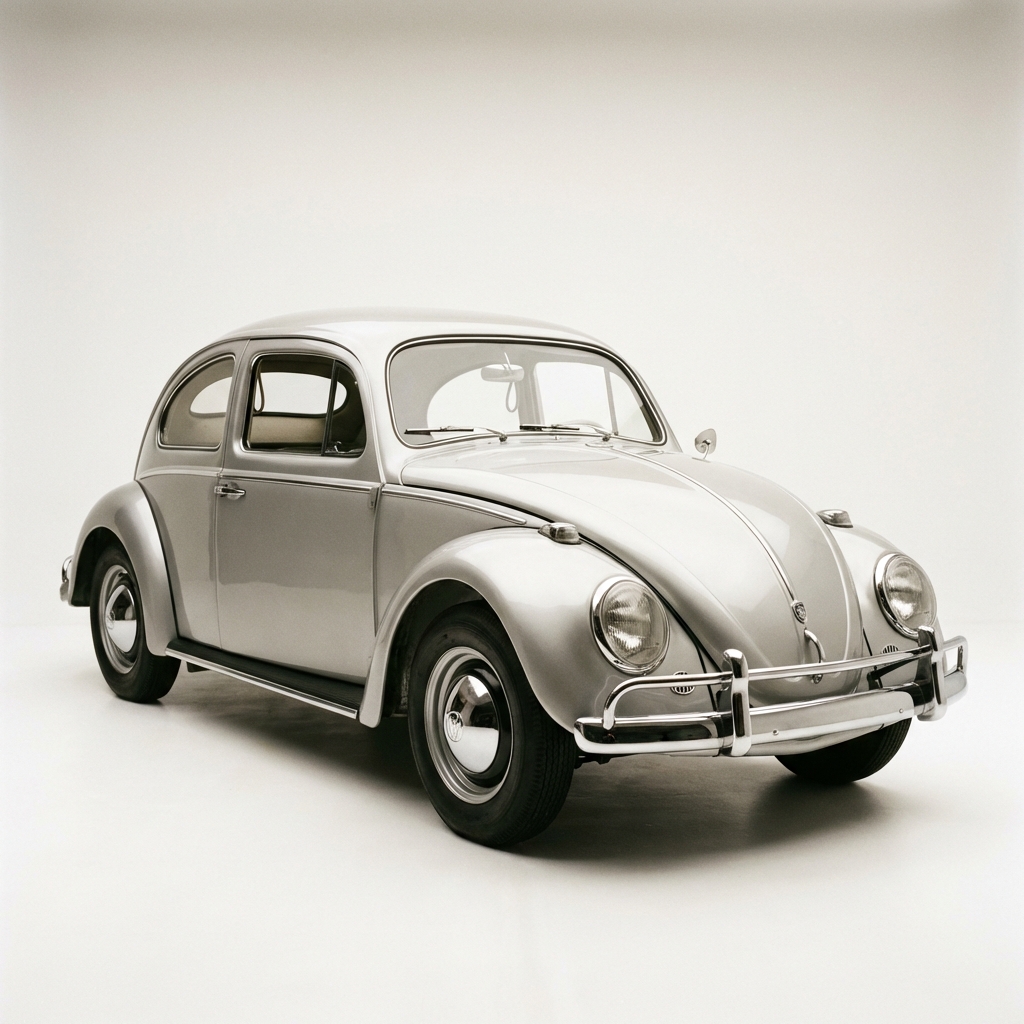
2-door sedan

1955 Beetle

1192cc
Displacement
30HP
Power
N/A
Top Speed

Real Stories

1949 VW Split Window Beetle - German Border Patrol
11:49

America Started Listening

In 1955, a car Americans had mostly ignored for five years began to click. Not because it changed — because America did. The oval window era Beetle found its first real American audience the year rock and roll did the same.

Elvis gyrated on Ed Sullivan. James Dean died in September. And a car that Americans had mostly ignored for five years suddenly started making sense. The 1955 Beetle didn't change dramatically. America changed around it.

Read the Full Story

Engineering.

The air-cooled flat-four that powered the 1955 Beetle. Simple, reliable, and endlessly modifiable.

1192cc

Air-cooled flat-4

The air-cooled flat-four engine that powered a generation. Code D.

Power
30 HP
Fuel
Carburetor

Highlights.

Engine

Engine Size

1192cc (1.192L) Air-cooled flat-4

Engine

Horsepower

30 HP

Engine

Engine Code

2

Feature

Body Style

2-door convertible

Quick Facts — 1955 Beetle

  • Engine SizeNeeds Review

    1192cc (1.192L) Air-cooled flat-4

  • HorsepowerNeeds Review

    30 HP

  • Engine CodeNeeds Review

    2

  • Body StyleNeeds Review

    2-door convertible

  • TransmissionNeeds Review

    4-speed manual (synchromesh 2nd-4th)

This is placeholder content generated for development purposes.

All specifications should be verified before publication.

Top Questions — 1955 Beetle

Refer to the specifications section above for the engine code used in the 1955 Beetle. The engine code is typically stamped on the engine case above the generator. For verification assistance, use our M-Code decoder tool.

Confidence: medium — This information should be verified with additional sources.

The value of a 1955 Beetle varies significantly based on condition, originality, and documentation. Driver-quality examples typically range from lower values, while excellent restored or numbers-matching examples command premiums. Condition, originality, and documentation are the primary value drivers. Always get a professional appraisal for insurance or sale purposes.

Confidence: low — This information requires verification before use.

1955 Beetle models were produced at various Volkswagen factories worldwide. Check the production details above for specific factory information. The factory code can often be identified through chassis number analysis.

Confidence: medium — This information should be verified with additional sources.

The 1955 Beetle received several updates from the 1954 model. Refer to the specifications and editorial sections above for detailed information about year-to-year changes. Changes may include mechanical updates, safety features, or cosmetic refinements.

Confidence: medium — This information should be verified with additional sources.

Common rust areas on air-cooled Volkswagens include heater channels (under running boards), floor pans (especially front and battery tray area), front beam (suspension mounting point), rear chassis/apron (where bumper mounts), and door bottoms. The heater channels are structural and expensive to repair. Always inspect these areas carefully before purchase.

The 1956 Beetle received updates from the 1955 model. Check the specifications section above for details about year-to-year evolution. Common changes across model years include safety updates, mechanical refinements, and regulatory compliance features.

Confidence: medium — This information should be verified with additional sources.

A full rotisserie restoration typically costs $25,000-$50,000+ depending on condition and level of finish. Mechanical refresh (engine, brakes, suspension) runs $5,000-$12,000. Bodywork and paint alone can be $8,000-$15,000 for quality work. DIY restorations save labor but require significant time investment (500-1,000 hours). Parts availability is generally good for classic VWs, which helps control costs.

Confidence: low — This information requires verification before use.

Numbers matching (original engine, transmission, and chassis) typically increases value by 20-40% over non-matching examples. However, the premium varies based on overall condition, documentation, and market demand. Use our numbers matching verification tool to check your vehicle.

Confidence: medium — This information should be verified with additional sources.

A well-maintained 1955 Beetle can serve as a daily driver, but consider the age of the vehicle. Modern traffic, safety features, and reliability expectations differ from the era. Regular maintenance, mechanical knowledge, and realistic expectations are essential. Many owners use classic VWs as weekend drivers or hobby vehicles rather than primary transportation.

Confidence: medium — This information should be verified with additional sources.

Yes, parts availability for classic air-cooled Volkswagens is generally excellent. The large enthusiast community and aftermarket support mean most mechanical and body parts are readily available. Some year-specific trim pieces or rare options may be harder to find, but the core mechanical components are well-supported.

Why This Year Matters

Needs Review
Collector AppealMedium
Restoration ComplexityMedium
Daily Driver SuitabilityMedium

Valuation Resources

Research current market values for the 1955 Beetle

Buying tip: Condition is everything. A rusty "project" can cost more to restore than buying a finished car. Check heater channels, floor pans, and battery tray first.

Which 1955 Beetle fits your style?

Explore the variants available for this model year and find your perfect match.

Want to see a detailed comparison of multiple vehicles?

Compare all variants

Verify Authenticity

Numbers matching verification increases value by 20-40%. Use our tools to verify engine codes, chassis numbers, and M-codes for your 1955 Beetle.

Correct Engine CodeD

The Full Story

Introduction

Elvis gyrated on Ed Sullivan. James Dean died in September. And a car that Americans had mostly ignored for five years suddenly started making sense. The 1955 Beetle didn't change dramatically. America changed around it.

What It Was

The oval rear window—introduced in 1953—had matured by 1955 into the Beetle's signature visual element. One large glass pane curved gracefully, eliminating the split window's blind spot while maintaining the car's rounded character. The design felt cohesive now, intentional. Chrome remained minimal: bumpers, window trim, nothing excessive. The paint palette expanded slightly—pastel greens and blues joined the conservative grays and blacks—but subtlety still defined the aesthetic.

The proportions stayed true to the original concept. Short overhangs. High roofline. Wheels pushed to the corners. Every element signaled efficiency over ostentation. While American cars grew fins and chrome teeth, the Beetle remained resolutely round, smooth, purposeful. That restraint began to read as sophistication rather than cheapness.

The dashboard evolved from painted metal to textured vinyl, a concession to comfort that didn't compromise simplicity. The instrument cluster remained minimal: speedometer, fuel gauge, nothing extraneous. Door panels gained some padding. These improvements felt earned, not arbitrary. VW was making the car better without making it different.

Younger buyers noticed this. The Beetle didn't scream for attention. It whispered intelligence. In an era when cars had become rolling status symbols, the Beetle represented something different: confidence to opt out of the arms race.

What Made It Special

The 1192cc engine produced 36 horsepower, a substantial increase from the original 25. The extra displacement came from boring out the cylinders—a simple, reliable approach that improved power without adding complexity. The result: the Beetle could now cruise at 65 mph without strain, merge onto highways without drama, climb hills without embarrassment.

Hydraulic brakes replaced the cable system, a major improvement in stopping power and consistency. Drivers no longer needed to adjust brake cables every few thousand miles. The pedal feel became predictable, confidence-inspiring. This wasn't high-tech wizardry. It was adopting proven technology when it made sense, not when marketing demanded it.

The torsion bar suspension gained adjustability, allowing owners to fine-tune the ride for different loads. The four-speed transmission now had synchromesh on all forward gears, making shifts smooth and effortless. These improvements demonstrated VW's philosophy: evolve the design through incremental refinement, not revolutionary reinvention.

Reliability remained the headline feature. Oil changes every 3,000 miles. Valve adjustments every 6,000. Spark plugs that lasted. The engine's air-cooled simplicity meant fewer things to break, and when something did break, owners could fix it themselves with basic tools and patience.

Cultural Context

1955 was the year teenage culture exploded into the American mainstream. Elvis Presley recorded "That's All Right" in 1954, but 1955 was when he became a phenomenon. Rock and roll shifted from niche to mainstream. James Dean's death in September made him an eternal symbol of youthful rebellion. Marlon Brando in The Wild One had already shown that rebellion could be cool. By 1955, rebellion had become marketable.

Cars sat at the center of this youth revolution. American teenagers used cars to escape parental supervision, to create their own mobile territories. Drive-in movies. Cruising. Dating. The automobile enabled teenage independence. But American cars were expensive, gas-guzzling, and often hand-me-downs from parents. They represented the establishment's values: bigger, flashier, more.

The Beetle offered an alternative narrative. Cheap to buy. Cheap to run. Weird enough to signal nonconformity. Practical enough to actually use. European enough to seem sophisticated. The handful of college students and young professionals who chose Beetles in 1955 weren't making a mainstream choice. They were making a statement about values. They were choosing substance over style, intelligence over excess.

This was still a tiny market. VW sold only about 30,000 Beetles in America in 1955. But those buyers planted seeds that would sprout into a revolution once DDB's "Think Small" campaign launched a few years later.

How It Drove

The 1955 cabin felt more finished than earlier Beetles. Cloth seats with some contouring. A padded dash. Door panels that didn't look like afterthoughts. The improvements were subtle but meaningful. You still sat upright, still looked out over that curved hood, still heard the engine's rhythmic hum behind you. But now the experience felt refined rather than austere.

The heater worked better—not well by modern standards, but better. Warm air actually reached the footwells on cold mornings. The windshield wipers gained a two-speed motor. The sunroof—optional but increasingly popular—transformed the cabin on summer days. These weren't revolutionary features. They were thoughtful responses to owner feedback.

The driving experience rewarded attention. The steering remained manual, requiring effort at parking speeds but delivering road feel that power steering would eliminate. The clutch pedal had weight. The shifter required deliberate movements. Nothing about driving a Beetle was automatic, which meant nothing about driving a Beetle was passive. You participated. That engagement became part of the appeal.

Younger buyers—teenagers who'd grown up with their parents' Buicks and Chryslers—found this participation refreshing. The Beetle didn't isolate you from the driving experience. It involved you. For a generation beginning to question conformity, that involvement felt authentic.

Who Bought It

The 1955 Beetle sedan's American buyers represented a demographic that wouldn't have a name for another decade. The early adopters — roughly 30,000 of them in America that year — were disproportionately educated, urban, and determined to resist the prevailing automotive logic. College towns. Coastal cities. The ZIP codes where bookstores outnumbered car dealerships.

European buyers remained the core. In Germany, the Wirtschaftswunder was creating a new middle class with disposable income and practical priorities — people who needed reliable transportation, not status signaling. The Beetle served both markets simultaneously: the European buyer who wanted dependability and the American buyer who wanted authenticity. These were, it turned out, almost the same person.

Buying Today

Volkswagen produced approximately 280,000 Beetles in 1955, triple the 1950 output. American sales remained small but growing steadily. The oval window era—which would end in 1957—represented the Beetle's adolescence, the years when VW refined the original concept without abandoning its core principles.

The 1955 model year also saw the introduction of the Karmann Ghia, a coachbuilt coupe sharing the Beetle's mechanicals. This demonstrated VW's understanding: the platform was sound enough to support premium bodywork. The Beetle's engineering had been validated. Now it was time to prove it could appeal to different markets.

By 1955, the Beetle's future was no longer in question. It had proven itself in Europe. American sales growth suggested it could succeed globally. The question wasn't whether the Beetle would survive. The question was how far this honest, simple approach could take VW. The answer—five more decades of continuous production—would have seemed impossible. But 1955 was the year it started feeling inevitable.

The Verdict

The original 1955 buyers—the early adopters who chose Beetles when it wasn't fashionable—remembered themselves as pioneers. They drove Beetles when neighbors drove Chevrolets and Fords. They defended their choice at dinner parties. They proved that a small, odd-looking German car could survive American highways, American winters, American skepticism. Twenty years later, when Beetles were everywhere, those early buyers reminded everyone: "We knew before you did."

Baby Boomers discovered 1955 Beetles in the 1970s as used cars—affordable, durable, characterful alternatives to bland Detroit sedans. The oval window era represented peak simplicity before later "improvements" added complexity. These Beetles became symbols of the 1950s innocence that Boomers romanticized, cars from before Kennedy's assassination, before Vietnam, before the world got complicated.

Today's enthusiasts restore 1955 Beetles because they represent the moment when the Beetle stopped being merely functional and started becoming iconic. The oval window era—1953 to 1957—captures the Beetle at its most purposeful, before safety regulations and modernization compromised the purity. A 1955 Beetle is simple enough to understand completely, reliable enough to drive regularly, and significant enough to matter historically. It's the Beetle as intended: honest engineering that doesn't apologize.