1955 Standard Sedan
1192cc30 HP
View Details
Reference review: source-recorded details; historical accuracy has not been comprehensively verified.
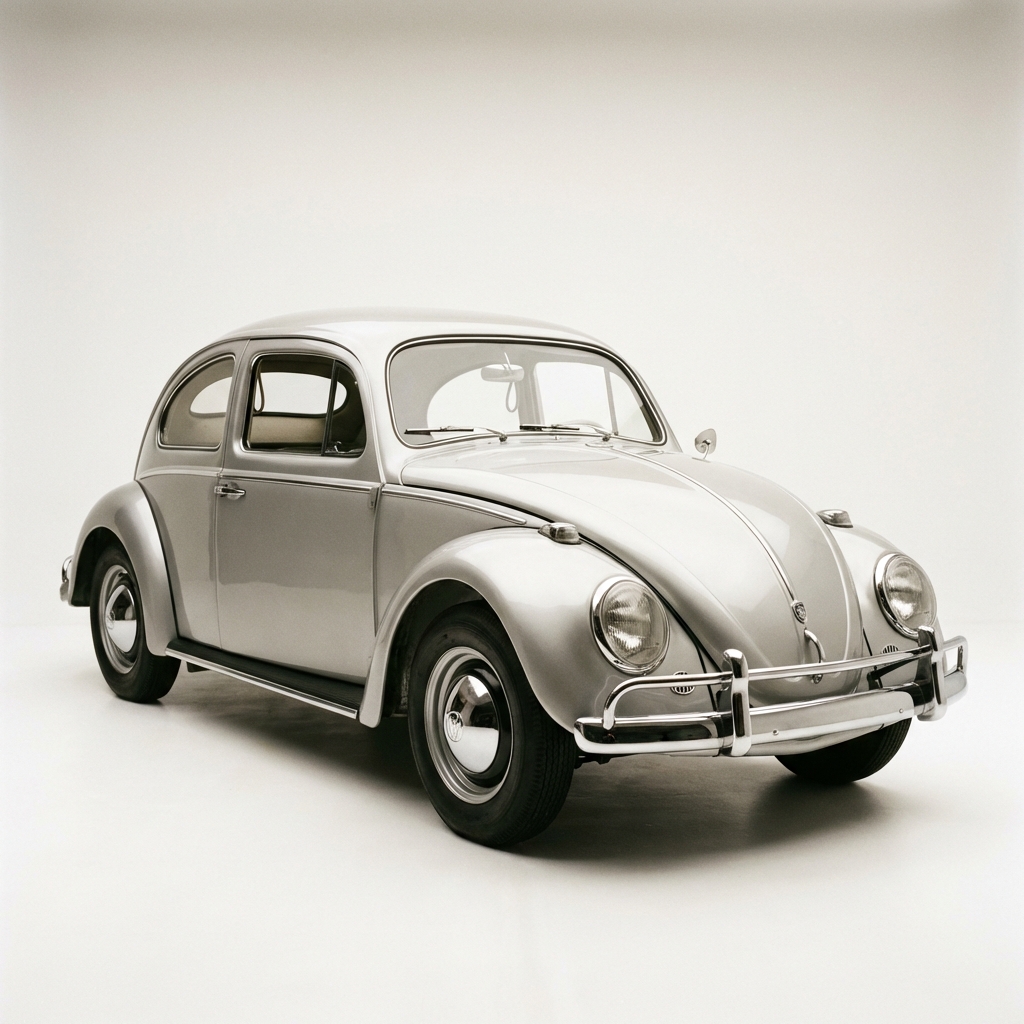
1192cc • 2-door sedan
Explore the 1956 Beetle: 36hp of pure rebellion, oval window charm, and accidental cool. When Elvis hit Ed Sullivan, VW hit America's sweet spot. Check authenticity guides and values.
Representative imagery. Depicted year, configuration and image rights remain unverified.

Featured story
The 1956 Standard Sedan is the only 1956 record with a story on file. Source candidate · under review.
Open the Standard Sedan record956: Elvis gyrated on Ed Sullivan, teenagers discovered purchasing power, and America watched a German economy car become accidentally cool. The Beetle hadn't changed—36 horsepower, air-cooled simplicity, that familiar curve of sheet metal. But the culture had shifted just enough to make simplicity look like wisdom and restraint feel like rebellion. VW wasn't trying to be counter-culture. They were just being German: practical, efficient, honest. America was ready for a different kind of rebellion—one that came with a spare tire and owner's manual instead of blue suede shoes. The same parents who feared rock & roll's influence found themselves drawn to a car that rejected chrome excess. Their teenagers discovered you could buy a used one for summer job money. Unintentional cool is the best kind of cool.
Displacement
From the 1956 Standard Sedan record.
The 1956 Beetle was 36 honest horses of German engineering wrapped in curves that Detroit wouldn't understand for another decade. Factory specs read like a minimalist manifesto: 1192cc air-cooled flat-four engine (because water freezes), four-speed manual transmission (because automatics are complicated), independent suspension (because solid axles are medieval). The oval rear window grew 20% larger than 1955—VW's idea of radical change was slightly better visibility. External door hinges appeared mid-1955, proving that sometimes progress looks like a step backward. The windshield gained a few degrees of rake because aerodynamics matter when you have 36 horsepower. Everything served function. Nothing served fashion. Detroit must have been baffled.
The 1956 Beetle wasn't special because it changed. It was special because it didn't. While Detroit reinvented sheet metal annually, VW refined what worked. The carburetor (28 PCI-1) got better fuel flow. The oil pump got stronger. The clutch got tougher. None of these changes would sell cars in showrooms. All of them would sell cars through word-of-mouth. The air-cooled engine meant no radiator, no coolant leaks, no freeze protection. Try explaining that to a Detroit engineer who just designed a triple-carburetor V8. The suspension used torsion bars and swing axles—technology that would look primitive on paper but feel sophisticated on rough roads. Everything about the car communicated mechanical honesty. It wasn't trying to be something it wasn't. In 1956, that felt like a revolutionary act.
From the 1956 Standard Sedan record.
1956 was the year America discovered it had teenagers. Elvis scared parents on Ed Sullivan, shown only from the waist up because his hips were apparently a national threat. James Dean's 'Rebel Without a Cause' was defining youth rebellion. The Interstate Highway System was approved, promising a future of high-speed travel. Detroit responded with chrome, fins, and horsepower. The '56 Chevy V8 made 205 horsepower—enough to power five Beetles and still have enough left for a coffee maker. Power steering was becoming standard because Americans apparently forgot how to turn wheels. Automatic transmissions were eliminating the need to understand how cars worked. Into this chrome-plated horsepower race rolled the Beetle, offering 36 honest horses and manual everything. It should have failed. Instead, it found two audiences: parents who saw wisdom in restraint, and teenagers who saw potential in simplicity. The same car could be either sensible or subversive, depending on who was driving. That accidental duality would define VW's American success for the next two decades.
The 1956 Beetle drove exactly like what it was: a German economy car that prioritized mechanical honesty over mechanical isolation. The steering told you what the front wheels were doing. The pedals had weight and travel that made sense. The shifter moved with precision that felt expensive. Nothing was power-assisted because nothing needed to be. Highway speeds required patience and a good understanding of momentum. The swing-axle rear suspension could get exciting if you didn't respect physics. The heater eventually produced heat, sort of. Modern drivers find it slow, loud, and involving. Modern drivers are missing the point. The Beetle wasn't trying to isolate you from the mechanical experience—it was trying to make you part of it. That's why it was more engaging than cars with triple the horsepower. Honesty beats horsepower.
1956 Beetle buyers fell into three camps, though VW only marketed to one. The intended audience: practical adults who valued engineering over styling, function over flash. They chose Beetles because the cars made sense, not because they made statements. The accidental audience: young buyers who discovered used Beetles were cheap, fixable, and perfect for customization. They chose Beetles because Detroit's offerings were too expensive and too complicated. The surprise audience: design-conscious intellectuals who saw the Beetle's restraint as a rejection of American excess. They chose Beetles because simplicity looked increasingly like wisdom. VW didn't plan this cultural trifecta. They just built honest cars and let America sort out what that meant.
The 1956 Beetle represented Peak Oval Window—the sweet spot between early-50s austerity and late-50s modernization. The oval rear window (20% larger than '55) improved visibility while maintaining the curved aesthetic that defined mid-50s VWs. External door hinges replaced the more elegant but less durable internal hinges. The windshield's rake increased slightly for better aerodynamics. Mechanical refinements were constant but subtle: stronger clutch, better carburetion, improved oil pump. VW wasn't trying to reinvent the Beetle. They were trying to perfect it. The strategy seemed quaint in 1956. By 1966, it would look prophetic. By 1976, it would be legendary. Sometimes evolution beats revolution.
2025 Market Values (USD): Concours examples command $45,000-65,000, because perfection isn't cheap. Excellent drivers bring $30,000-40,000, because usability matters. Good drivers fetch $20,000-25,000, because character counts. Projects start at $5,000, because optimism springs eternal. Oval window Beetles occupy an interesting market position—not as valuable as split-windows, not as practical as later cars, but representing peak vintage VW character. Investment outlook: Strong. As early Beetles cross $100K, 1956 specimens look increasingly attractive. But don't buy one as an investment. Buy one because it represents the year when German engineering accidentally became cool. The ROI is in the story, not the spreadsheet.
Restoring a '56 Beetle requires equal parts mechanical skill and cultural archaeology. Common issues: Heater channels rust (because German steel met American salt). Floor pans dissolve (because gravity exists). Door hinges wear (because external mounting was new technology). Engine parts are plentiful because VW built millions. Body parts are available because the aftermarket exists. Interior pieces require hunting because authenticity matters. The oval rear window is specific to 1953-57—don't break it. The semaphore turn signals are delightful and complicated. Parts sources: Mexico for engine bits, Germany for body steel, Brazil for the stuff Germany stopped making. Budget reality: $40,000 for a proper restoration. You'll never get it back in cash. You'll get it back in stories. That's the point.
The 1956 Beetle is the car that proved German engineering and American counter-culture could coexist. It wasn't the fastest (36hp saw to that). It wasn't the most comfortable (the heater was theoretical). It wasn't the most practical (the trunk was in front, because why not). But it was honest in an era of automotive hyperbole, simple in an age of increasing complexity, and somehow cool without trying. That's why it matters. Buy one if: You understand that progress doesn't always mean improvement. You appreciate mechanical honesty. You want to own the year when Elvis and engineering intersected. Don't buy one if: You need to arrive quickly. You prefer your classics with power steering. You think 36 horsepower is a typo. It's not. That's the whole point.
1,216 words • ~7 min read
Research current market values for the 1956 Beetle
Hagerty Valuation Tools
Industry-standard classic car values
Bring a Trailer Results
Recent auction prices
TheSamba Classifieds
Current listings & asking prices
Buying tip: Condition is everything. A rusty "project" can cost more to restore than buying a finished car. Check heater channels, floor pans, and battery tray first.
Identity under review
This story
Some of this works today. Some of it is still an idea. The chips say which.