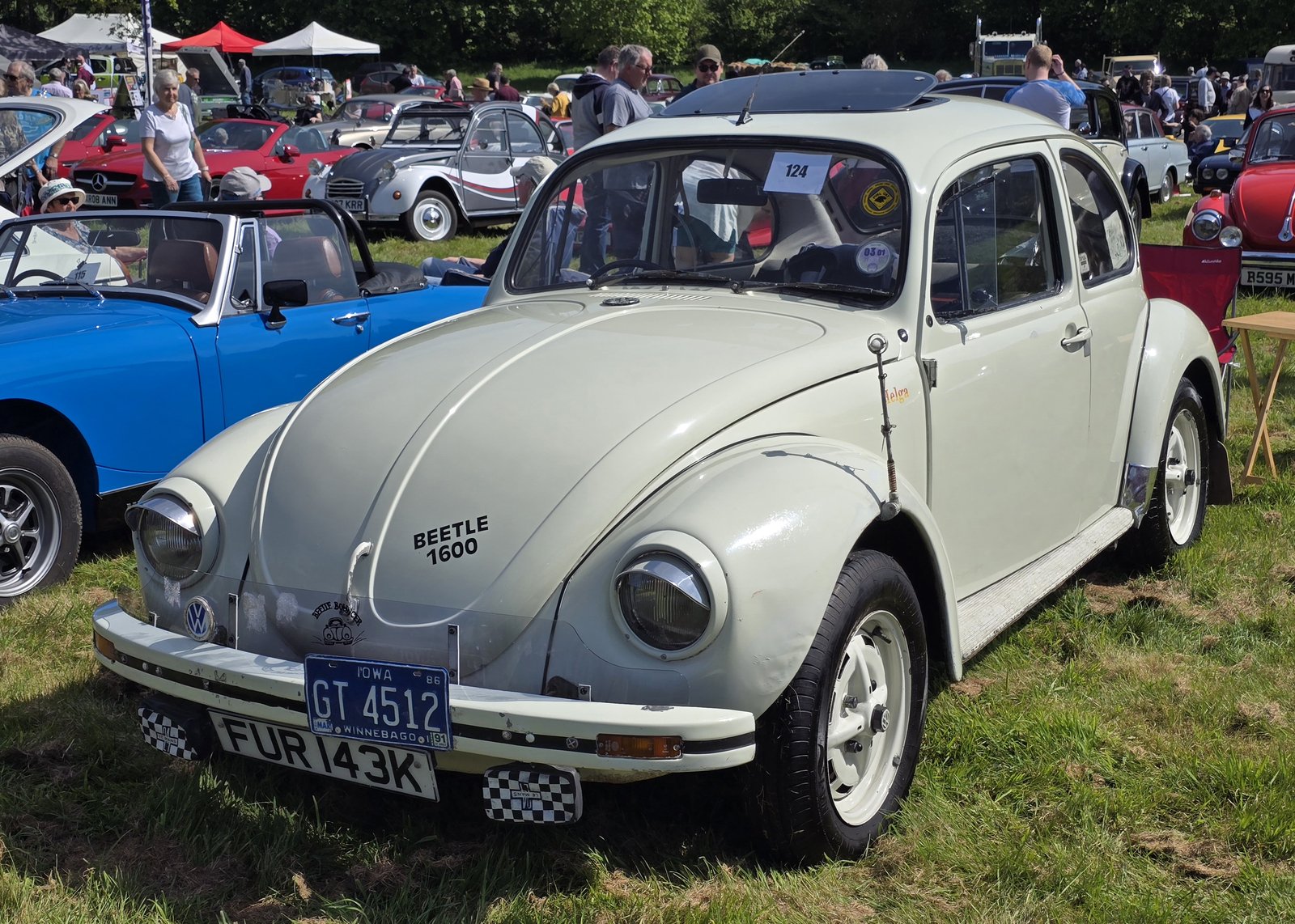
1200cc
Air-cooled flat-4
The air-cooled flat-four engine that powered a generation. Code D, AB, AC, AD, AE, AF.
- Power
- 40 HP
- Fuel
- Carburetor


Factory exterior

1971: Super Beetle Convertible debuted combining MacPherson strut suspension innovation with Karmann coachbuilding tradition and open-air California freedom. The engineering advancement was substantial—MacPherson struts provided better handling geometry, larger front trunk from space efficiency, improved ride quality from reduced unsprung weight. But the soul remained purely convertible: canvas top manually operated, open sky overhead when weather cooperated, California lifestyle maintained through engineering evolution. The Super convertible proved you could modernize significantly while preserving essential character. That balance—meaningful mechanical advancement within consistent philosophical identity—exemplified VW's approach to evolution and validated California's embrace of convertibles as icons that could adapt without betraying core values.
The air-cooled flat-four that powered the 1971 Beetle. Simple, reliable, and endlessly modifiable.
1600cc (1.6L) Air-cooled flat-4
60 HP
Dual-port 1600
2-door sedan
4-speed manual / 3-speed AutoStick
1971: Nixon continued Vietnam War despite promising peace.
All specifications should be verified before publication.
Refer to the specifications section above for the engine code used in the 1971 Beetle. The engine code is typically stamped on the engine case above the generator. For verification assistance, use our M-Code decoder tool.
Confidence: medium — This information should be verified with additional sources.
The value of a 1971 Beetle varies significantly based on condition, originality, and documentation. Driver-quality examples typically range from lower values, while excellent restored or numbers-matching examples command premiums. Condition, originality, and documentation are the primary value drivers. Always get a professional appraisal for insurance or sale purposes.
Confidence: low — This information requires verification before use.
1971 Beetle models were produced at various Volkswagen factories worldwide. Check the production details above for specific factory information. The factory code can often be identified through chassis number analysis.
Confidence: medium — This information should be verified with additional sources.
Key changes for the 1971 Beetle: available components. But the core remained unchanged: same air. cooled flat. four engine (1300cc or 1600cc options), same fundamental simplicity, same owner. Check the specifications section for complete details about year-to-year evolution.
Confidence: medium — This information should be verified with additional sources.
Common rust areas on air-cooled Volkswagens include heater channels (under running boards), floor pans (especially front and battery tray area), front beam (suspension mounting point), rear chassis/apron (where bumper mounts), and door bottoms. The heater channels are structural and expensive to repair. Always inspect these areas carefully before purchase.
The 1972 Beetle received updates from the 1971 model. Check the specifications section above for details about year-to-year evolution. Common changes across model years include safety updates, mechanical refinements, and regulatory compliance features.
Confidence: medium — This information should be verified with additional sources.
A full rotisserie restoration typically costs $25,000-$50,000+ depending on condition and level of finish. Mechanical refresh (engine, brakes, suspension) runs $5,000-$12,000. Bodywork and paint alone can be $8,000-$15,000 for quality work. DIY restorations save labor but require significant time investment (500-1,000 hours). Parts availability is generally good for classic VWs, which helps control costs.
Confidence: low — This information requires verification before use.
A well-maintained 1971 Beetle can serve as a daily driver, but consider the age of the vehicle. Modern traffic, safety features, and reliability expectations differ from the era. Regular maintenance, mechanical knowledge, and realistic expectations are essential. Many owners use classic VWs as weekend drivers or hobby vehicles rather than primary transportation.
Confidence: medium — This information should be verified with additional sources.
Yes, parts availability for classic air-cooled Volkswagens is generally excellent. The large enthusiast community and aftermarket support mean most mechanical and body parts are readily available. Some year-specific trim pieces or rare options may be harder to find, but the core mechanical components are well-supported.
Research current market values for the 1971 Beetle
Hagerty Valuation Tools
Industry-standard classic car values
Bring a Trailer Results
Recent auction prices
TheSamba Classifieds
Current listings & asking prices
Buying tip: Condition is everything. A rusty "project" can cost more to restore than buying a finished car. Check heater channels, floor pans, and battery tray first.

Original paint options available for the 1971 Beetle.
Looking for a 1971 Beetle in Mint Green?
Find for SaleExplore the variants available for this model year and find your perfect match.
Want to see a detailed comparison of multiple vehicles?
Compare all variantsNumbers matching verification increases value by 20-40%. Use our tools to verify engine codes, chassis numbers, and M-codes for your 1971 Beetle.
1971: Super Beetle Convertible debuted combining MacPherson strut suspension innovation with Karmann coachbuilding tradition and open-air California freedom. The engineering advancement was substantial—MacPherson struts provided better handling geometry, larger front trunk from space efficiency, improved ride quality from reduced unsprung weight. But the soul remained purely convertible: canvas top manually operated, open sky overhead when weather cooperated, California lifestyle maintained through engineering evolution. The Super convertible proved you could modernize significantly while preserving essential character. That balance—meaningful mechanical advancement within consistent philosophical identity—exemplified VW's approach to evolution and validated California's embrace of convertibles as icons that could adapt without betraying core values.
The Super Beetle convertible's most distinctive visual elements were the curved windshield and bulging hood accommodating MacPherson strut towers. The design changes were purely functional—new suspension required different packaging—and VW didn't hide this with styling tricks. The hood bulge was honest: this is where modern suspension lives, this is what it looks like. That transparency aligned with both Beetle tradition (form follows function, never disguise engineering reality) and environmental movement values (no wasteful styling, just functional design). The curved windshield improved aerodynamics meaningfully, reducing drag and improving fuel economy—environmental benefit through intelligent design rather than just restriction.
The overall proportions remained recognizably Beetle despite the functional changes. With top down, the Super convertible revealed evolved sculpture: bulged hood showing engineering advancement, curved windshield suggesting aerodynamic sophistication, maintained rounded fenders preserving Beetle character, upright profile retaining honest proportions. Paint colors in 1971 offered environmental-era appropriate choices: earth tones suggesting ecological consciousness, ocean blues connecting to California, forest greens reflecting back-to-nature values. Many owners chose natural colors rather than flashy ones—reflecting shift from counterculture psychedelia to environmental earthiness. The interior featured Karmann quality materials: upgraded vinyl, better carpeting, refined dashboard details. Everything communicated coachbuilt craftsmanship justifying premium pricing through tangible superior construction and materials.
The Super Beetle convertible's defining engineering advancement was MacPherson strut front suspension replacing the torsion bars VW had used since 1949. The change provided multiple measurable benefits: improved handling through superior geometry allowing better camber control during cornering, larger front trunk (increased from 5 cubic feet to 8.9 cubic feet) enabling better luggage capacity for extended road trips, better ride quality from reduced unsprung weight improving bump absorption, more modern engineering using readily-available components easier to source and service. But the change maintained Beetle core values: the MacPherson struts could be serviced by competent home mechanics with basic tools and shop manual, the system was mechanically transparent rather than complex black box, the components were durable German engineering rather than disposable assemblies.
Karmann's convertible-specific engineering maintained structural integrity despite removed roof and new suspension. The reinforcements were sophisticated: strengthened chassis rails compensating for missing roof structure, enhanced sill bracing preventing lateral flex during cornering, reinforced bulkhead maintaining front-end rigidity, additional underbody bracing preserving torsional stiffness. The result was convertible that drove confidently with top down—no cowl shake disturbing steering feel, minimal body flex compromising handling, maintained structural rigidity inspiring confidence on mountain roads and highways. That engineering proved German coachbuilding expertise: the Super convertible wasn't sedan with roof removed—it was purpose-engineered convertible maintaining performance through intelligent structural compensation.
The 1600cc air-cooled engine producing 60 HP (in pre-emissions specification) provided meaningful power for California driving. Pacific Coast Highway cruising benefited from improved passing capability when roads allowed. Mountain driving to Big Sur or Yosemite improved through stronger acceleration up grades. Highway merging became more confident with 50% more power than original 1200cc's 40 HP. But the air-cooled architecture maintained environmental advantages: no coolant to dispose of or leak into groundwater, no antifreeze contaminating ecosystems, no radiator to manufacture and eventually scrap, continued fuel efficiency delivering 28-32 mpg despite power increase, owner-serviceable maintenance procedures remaining accessible to competent mechanics with tools and manuals.
1971: Environmental movement was maturing from protest to policy. Earth Day 1970 had mobilized 20 million Americans—largest demonstration in US history. Clean Air Act was being implemented with expanding EPA oversight. Environmental Protection Agency was establishing enforcement powers. Ecological consciousness was shifting from counterculture fringe to mainstream concern. California was leading: strictest emissions standards, strongest environmental regulations, most active ecological activism. The Super Beetle convertible launched into this environmental consciousness moment—demonstrating that ecological values could drive engineering innovation rather than just constraining it.
The convertible represented environmental sophistication: improved suspension serving efficiency and safety, larger trunk enabling sustainable travel alternatives to flying, maintained simplicity preserving resource consciousness, continued fuel efficiency honoring ecological responsibility, owner-serviceability supporting self-sufficient values, durability embodying anti-obsolescence activism. Every engineering characteristic aligned with environmental movement values while improving function. The Super convertible proved environmental consciousness could advance automotive capability through intelligent design—exactly what California environmental activists advocated as alternative to restriction and regression.
California counterculture was fragmenting in 1971. Some retreated to communes seeking complete separation from mainstream. Some integrated back into establishment with long hair but straight jobs. Some turned militant embracing Weather Underground violence. Some channeled activism into environmental movement seeking systemic change through policy and regulation. The Super Beetle convertible served all fragments: practical enough for integrated hippies working straight jobs, efficient enough for communards with limited resources, reliable enough for activists needing dependable transportation, environmental enough for ecology-focused movement members. That versatility across fragmenting movement demonstrated the values were deeper than any specific faction. Honesty, simplicity, efficiency, durability, accessibility—these transcended whether you chose commune or career, militant or peaceful, political or ecological.
Climbing into the Super Beetle convertible meant experiencing refined California engineering. The larger front trunk transformed practical utility—week-long camping trips became feasible with significantly more gear capacity, cross-country road trips to environmental gatherings or back-to-land communes carried more supplies, moving to alternative living situations accommodated more belongings. The curved windshield improved visibility and reduced wind buffeting with top down—aerodynamic sophistication making open-air driving more pleasant at highway speeds. The MacPherson suspension delivered noticeably improved ride quality—bumps were absorbed more smoothly, handling felt more sophisticated, mountain roads could be driven more confidently.
The controls maintained Beetle mechanical directness and engagement. The steering communicated road feel honestly through the MacPherson suspension geometry—you felt grip levels, understood weight transfer, sensed traction limits through tactile feedback. The gearshift remained precise and mechanically engaging—deliberate movements rewarded with positive engagement, smooth technique resulting in satisfying mechanical operation. The clutch pedal was progressive and communicative—you felt exactly where engagement occurred, understood what the drivetrain was doing, trusted the feedback. Everything maintained Beetle tradition of mechanical transparency: you were engaged with car's operation, understanding what was happening, trusting through knowledge rather than despite ignorance.
Living with a Super Beetle convertible in early-1970s California meant experiencing environmental sophistication through modern engineering serving ecological values. Earth Day in 1970 had crystallized environmental consciousness as mainstream concern rather than fringe activism. The Super convertible demonstrated that environmental values could drive engineering advancement: MacPherson suspension improved efficiency through better aerodynamics and handling, larger trunk enabled long trips replacing short flights, curved windshield reduced drag improving fuel economy, maintained air-cooled simplicity preserving environmental advantages. The convertible proved environmental engineering could mean better function AND reduced impact through intelligent design rather than just restriction and sacrifice.
The 1971 Beetle convertible buyer was making a choice, which is different from making a compromise. At 40 horsepower, the 1200cc engine made no pretense of performance; what it offered was a Karmann-built convertible at a price that remained accessible to working people with ambitions and good judgment. Young women bought these in numbers that consistently surprised dealers who hadn't been paying attention. Young couples bought them as the fun car, the secondary car, the car you took when you didn't need to take much with you. California sold the most. Florida was close behind. But buyers in New England and the upper Midwest bought them too, because some purchases are about more than meteorology. They're about deciding what kind of person you intend to be.
Karmann built the first full production year of Super Beetle convertibles in 1971 with maintained coachbuilding quality standards despite significant engineering changes required to accommodate MacPherson suspension. The structural reinforcements proved robust. The canvas top engineering remained excellent. California market embraced the modern capability while appreciating maintained character—improved function without betrayed identity. Many 1971 Super convertibles remained in California ownership for decades, proving that engineering advancement within consistent philosophy created enduring value. The cars demonstrated you could innovate substantially while maintaining core identity—lesson applicable beyond automotive context to any endeavor balancing progress with principle, advancement with authenticity, evolution with essence.
Original 1971 Super convertible buyers chose sophisticated environmental engineering that improved function while maintaining ecological values. They understood that environmental consciousness and engineering advancement weren't contradictory when design was intelligent. The MacPherson suspension was genuine innovation improving handling and utility. The larger trunk enabled sustainable travel. The improved aerodynamics enhanced efficiency. But the air-cooled simplicity, owner-serviceability, fuel economy, and anti-obsolescence durability remained unchanged. They got better performance AND maintained environmental responsibility through intelligent design rather than just accepting less in name of ecology.
Enthusiasts and collectors recognize the Super Beetle convertible's introduction as demonstrating environmental values could drive innovation. The MacPherson suspension was substantial engineering change—most significant revision to Beetle platform since original 1949 design. But the environmental benefits remained: fuel efficiency, longevity, owner-serviceability, resource consciousness. That proves environmental thinking as advancement driver rather than just constraint imposer. The 1971 Super convertible pioneered that sophisticated environmental engineering approach: innovate to serve ecological values better, don't just restrict to reduce impact minimally.
Today's restorers value 1971 Super Beetle convertibles because they represent environmental sophistication recognizing ecology and engineering can advance together through intelligent honest design. Modern environmental discourse sometimes suggests sustainability requires sacrifice and regression. The 1971 Super convertible demonstrated otherwise: intelligent design improves function while reducing impact, honest engineering advances capability while maintaining principles, sophisticated thinking serves environmental values through innovation rather than just restriction. Restoring a 1971 Super convertible means preserving that lesson: environmental responsibility and engineering progress complement when thinking is sophisticated, design is intelligent, and values drive innovation rather than just constraining it.