Reference review: source-recorded details; historical accuracy has not been comprehensively verified.
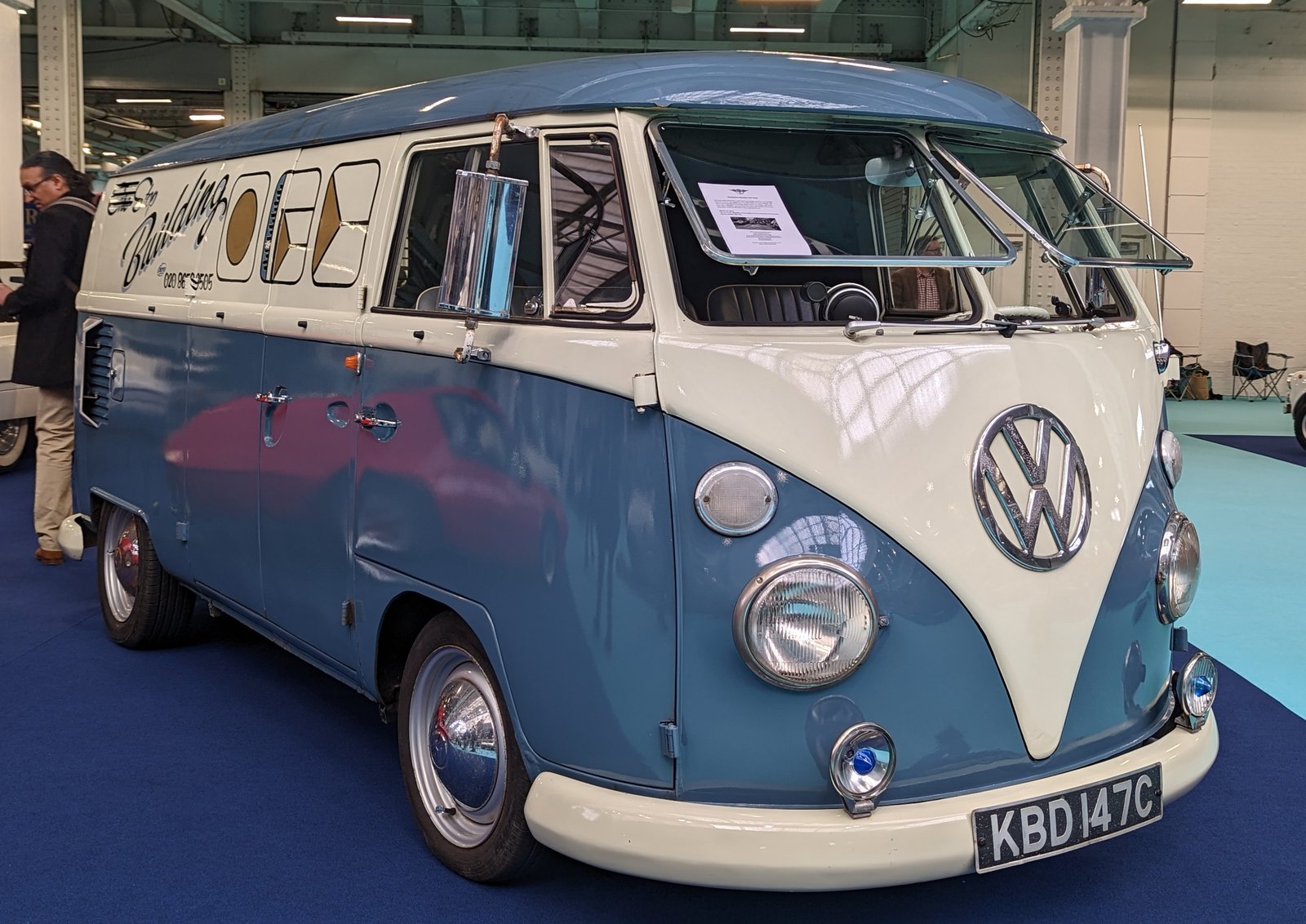
1965 · Bus
1965 Bus
We hold 6 records for the 1965 Bus: 3 body styles, specifications and factory colours. No story has been published for this year. A story is recorded against a record whose identity is under review. It is below, labelled.
Real Stories


We hold 6 records for the 1965 Bus: 3 body styles, specifications and factory colours. No story has been published for this year. A story is recorded against a record whose identity is under review. It is below, labelled.
1965 body styles
1965 T1 Double Cab
Reference only
- Engine:
- 1500cc
- Power:
- Not recorded
- Body style:
- Pickup
- BlackL41
- Fontana GreyL595
- Ruby RedL456
- Sea SandL568
1965 T1 Microbus
Identity under review · story recorded
1965 T1 Single Cab
Reference only
- Engine:
- 1500cc
- Power:
- Not recorded
- Body style:
- Pickup
- BlackL41
- Fontana GreyL595
- Ruby RedL456
- Sea SandL568
Factory colours recorded for 1965
Paint codes whose recorded availability covers 1965, from the VWX colour reference. They are not tied to any record on this page; year applicability remains under review.
- Henna RedL5531965-1966
- Arcona WhiteL5821965-1966
- Safari BeigeL5631964-1965
- Baltic BlueL5391965-1967
- Roulette GreenL5441965-1967
- Sea SandL5681965-1967
- Fontana GreyL5951965-1967
- Pacific BlueL3961962-1966
- Ruby RedL4561961-1965
- Bahama BlueL5191965-1970
- Sea BlueL3601964-1970
- Java GreenL5181964-1970
Identity under review
1965 Type 2 Microbus: When Simple Engineering Met Social Revolution
More than one record claims this car, and VWX has not picked one. So the specifications, the colours and the factory data stay off this page. The story does not: it was written from the sources we hold, and hiding it would not make the car any clearer.
Reference review: source-recorded details; historical accuracy has not been comprehensively verified.
Open the T1 Microbus recordThe story on file
965: Vietnam escalating, civil rights marching, Dylan going electric. America was questioning everything—including how to move through the world. Detroit answered with chrome and horsepower. Volkswagen answered with a box on wheels. The 1965 Type 2 Microbus wasn't trying to be revolutionary. It was trying to be practical: eight seats, flat floor, air-cooled reliability. But practicality, it turned out, was exactly what revolution needed. The split-window Bus became counterculture's wheels not through marketing but through honest engineering. VW built it to move people and cargo. The people it moved happened to be changing the world.
Model Information and History
What It Was
The 1965 Type 2 was honest transportation, built around simple math: maximum space, minimum complexity. Factory specifications tell the story: Engine: 1500cc flat-four, 53 horsepower (SAE), air-cooled. Transmission: 4-speed manual, floor shift. Body: Forward control (driver above front axle), split windscreen, sliding side door. Capacity: Eight passengers or 1,830 pounds of cargo. Dimensions: 168 inches long, 67.2 inches wide, 77.2 inches tall. Wheelbase: 94.5 inches. Features: Fold-down middle seat, rear bench, opening safari windshields, fresh air ventilation system. The numbers don't capture the innovation: the flat floor that enabled infinite configurations, the visibility that made cities navigable, the simplicity that made owners into mechanics. VW wasn't building a cultural icon. They were building practical transport. Sometimes practicality changes culture.
What Made It Special
The 1965 Type 2's magic wasn't in its specifications—it was in its space. The forward control layout put the driver above the front wheels, eliminating the engine compartment. The result: a flat floor from bumper to bumper, a box of possibilities. The split windscreen wasn't style—it was structural. Two flat panes were cheaper than one curved piece. The safari windows opened for ventilation because air conditioning wasn't an option. The sliding door was revolutionary in 1950, still practical in 1965. Every feature served function. That honesty became style. The 1500cc engine was new for '63, bringing actual highway capability. Fifty-three horsepower meant maintaining 65mph without prayer. The four-speed transmission was fully synchronized—no more double-clutching. The fresh air system almost worked. Almost. The Type 2 remained slow, basic transport. But it was honest about it. That honesty made it special.
Cultural Context
1965 was inflection point and paradox. America was both expanding and contracting: expanding awareness (civil rights, women's liberation, environmental consciousness) while contracting assumptions (nuclear family, nine-to-five work, suburban destiny). The Type 2 Bus straddled both worlds. For traditional families: practical transport, weekend camping, Little League duty. For the emerging counterculture: mobile living room, protest transport, escape pod from convention. The automotive landscape was pure American muscle: Pontiac GTO, Ford Mustang, Chevrolet Chevelle. Power was the point. The Bus offered different power: the ability to carry eight people, to live differently, to reject chrome and horsepower for simplicity and space. Detroit was selling speed. VW was selling freedom. The Bus's engineering matched emerging values: simplicity over complexity, function over flash, community over individual. You could maintain it yourself—a rejection of dealer dependence. You could sleep in it—a rejection of fixed addresses. You could paint it—a rejection of corporate aesthetics. The Type 2 became counterculture's wheels because it enabled counterculture's ideas. Not through marketing. Through engineering.
How It Drove
The 1965 Type 2 drove exactly as it looked: tall, deliberate, honest. The 1500cc engine moved it adequately—0-60mph in about 37 seconds, top speed around 65mph. Highway travel required planning and patience. Crosswinds made it interesting. The steering was light but vague—you guided more than steered. The four-speed transmission shifted cleanly. The brakes worked eventually. Today, driving a '65 Bus is time travel. Everything requires intention: acceleration, braking, cornering. No power assistance. No electronic aids. Just mechanical feedback and gravity awareness. The visibility remains extraordinary—the split screen and safari windows create fishbowl awareness. The seating position is kitchen chair upright. The engine's sound is industrial sewing machine, the gear whine is 1950s honest. It's slow by modern standards. It's perfect by character standards.
Who Bought It
The 1965 Type 2 served three distinct tribes: The Practical Families: Needed eight seats, liked German engineering, didn't need status. The Bus was honest family transport when station wagons were status symbols. The Early Adopters: Artists, surfers, musicians. They saw the space and possibility before everyone else. The Bus was studio, hotel room, gear hauler. The Emerging Counterculture: Communes, protesters, wanderers. They needed affordable, maintainable group transport. The Bus was enabler and symbol. VW marketed to the first group. The other two happened organically. The Bus cost $2,365 new—expensive for a Volkswagen, cheap for what it enabled. It competed with station wagons on price but offered something station wagons couldn't: permission to live differently.
Evolution
The 1965 Type 2 represented peak development of the first-generation Bus. Evolution from 1950 launch: 1953: Deluxe model with chrome and two-tone paint. 1955: High roof delivery van option. 1963: 1500cc engine replaces 1200cc. 1964: Wider rear door, improved heater. 1965: Fresh air system redesigned, larger taillights. The basic format remained unchanged: forward control, split screen, air-cooled simplicity. The 1967 model would bring major changes: larger windows, different taillights, 1600cc engine. The split screen would disappear. The first generation's purity would end. The '65 represents final development of Volkswagen's original vision: maximum space, minimum complexity, honest function. It's the last pure expression of Ben Pon's original sketch: a box on wheels, drawn in 1947, that changed mobility.
Today
2025 Market Values (USD): Concours: $75,000-120,000 (23-window Deluxe). Excellent: $45,000-85,000. Good: $25,000-45,000. Fair: $15,000-25,000. Project: $5,000-15,000. The market splits between standard and Deluxe models. 23-window Deluxe models command premium prices. Standard buses remain (relatively) affordable. Condition matters more than options. Rust matters most. Investment outlook: Strong. Values continue climbing. Cultural significance drives collector interest. The '65's position as 'last of pure split-screens' adds value. Buy the best you can afford. Projects cost more to restore than buy finished. Authenticity matters: numbers matching, correct colors, original features bring premiums.
Restoration
Restoring a '65 Bus requires three things: patience, money, and metalwork skills. Common issues: Rust everywhere—rockers, floor pans, wheel wells, cargo floor, battery tray. Check the heater channels first—they're structural. Engine accessibility is good. Parts availability varies: Mechanical parts: Excellent. Most engine/transmission components reproduced. Body panels: Good. Heritage Parts now stamps complete panels. Interior: Fair. Original materials unavailable, but quality reproductions exist. Trim: Challenging. Split-screen specific parts command premiums. Special tools needed: Metric tools, Bus-specific spring plate tool, authentic paint codes. Budget reality: Full restoration costs $60,000-120,000 at professional shops. DIY cuts labor but requires skills. Rust repair is the major cost. Get a professional evaluation before starting. Join a club—the knowledge base is invaluable.
The Bottom Line
The 1965 Type 2 Microbus is the last and best of the pure split-screens. It's the most developed first-generation Bus, with the best engine (1500cc), best transmission (fully synchronized), and most refined features. It's also the final expression of VW's original vision: honest transport, maximum space, minimum complexity. Perfect for: People who value purity over convenience. Collectors who understand significance. Anyone who believes slow transport can enable fast changes. Not for: People who need to arrive quickly. Buyers seeking easy restoration projects. Those afraid of crosswinds. The '65 Bus is transport that became transformation. VW built it to move people. The people moved culture.
Nearby years
Explore the ecosystem
Some of this works today. Some of it is still an idea. The chips say which.