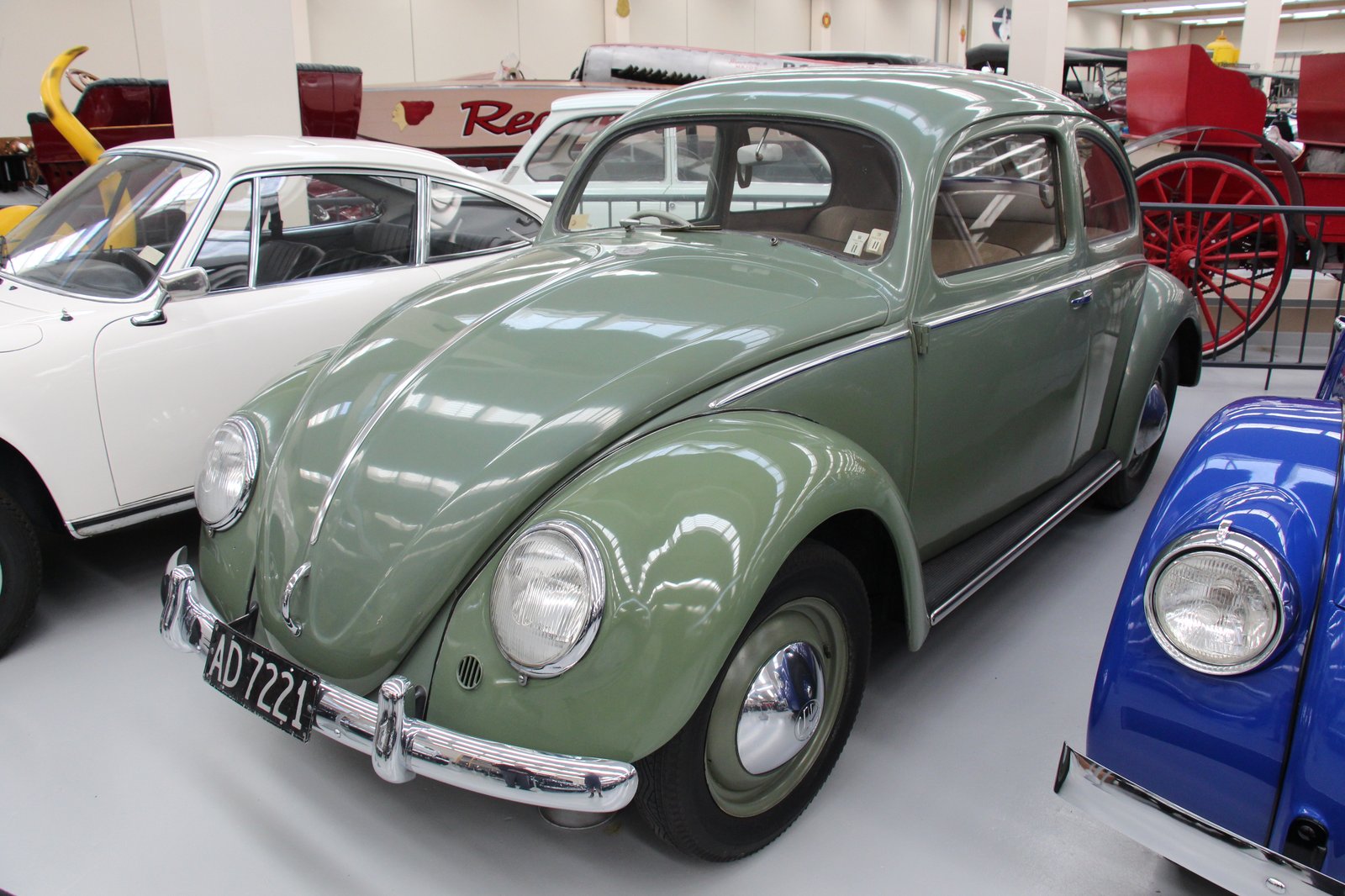
2-door sedan

1953 Beetle

1192cc
Displacement
30HP
Power
N/A
Top Speed

Real Stories

1949 VW Split Window Beetle - German Border Patrol
11:49

1953: When VW Split the Window and United a Movement

Explore the 1953 Beetle's pivotal transition from split to oval window. 30hp of revolution, two distinct identities, and the moment VW chose engineering over marketing.

1953: Eisenhower in office, Korea in armistice, America in love with chrome. And there's VW, casually revolutionizing automotive history by changing a window. March 1953: without fanfare, marketing campaigns, or even a press release, VW replaced the iconic split rear window with a single oval pane. Early '53 buyers got the last split windows. Late '53 buyers got the first ovals. Nobody got a warning. Detroit would have made this a three-year marketing campaign. VW treated it like a Tuesday.

They didn't know they were creating collector categories, defining restoration taxonomies, or launching decades of 'split vs. oval' debates. They were just making the back window work better. That's the most VW thing ever: accidentally making history while trying to improve visibility.

Read the Full Story

Engineering.

The air-cooled flat-four that powered the 1953 Beetle. Simple, reliable, and endlessly modifiable.

1192cc

Air-cooled flat-4

The air-cooled flat-four engine that powered a generation. Code Type 122 engine (30 hp unit).

Power
30 HP
Fuel
Carburetor

Highlights.

Feature

Cultural context

revolutionary

Engine

The 1953 Beetle did somethi...

it made engineering decisions without consulting marketing.

Engine

Engine Size

1192cc (1.192L) Air-cooled flat-4

Engine

Horsepower

30 HP

Quick Facts — 1953 Beetle

  • Engine SizeNeeds Review

    1192cc (1.192L) Air-cooled flat-4

  • HorsepowerNeeds Review

    30 HP

  • Engine CodeNeeds Review

    Type 122 engine (30 hp unit)

  • Body StyleNeeds Review

    2-door sedan

  • TransmissionNeeds Review

    4-speed manual (2nd-4th synchromesh introduced mid-1952)

  • Current Market ValueNeeds Review

    Excellent: $25,000-35,000. Good: $15,000-20,000. Project: $5,000-10,000.

    Values from editorial 'Today' section, market conditions vary

  • Cultural SignificanceNeeds Review

    1953 America was peak chrome.

  • Common Rust AreasNeeds Review

    Check: heater channels

All specifications should be verified before publication.

Top Questions — 1953 Beetle

Refer to the specifications section above for the engine code used in the 1953 Beetle. The engine code is typically stamped on the engine case above the generator. For verification assistance, use our M-Code decoder tool.

Confidence: medium — This information should be verified with additional sources.

A 1953 Beetle's value ranges from $5,000-10,000 for project cars, $15,000-20,000 for good drivers, $25,000-35,000 for excellent restored examples, $40,000-50,000 for show-quality examples. Condition, originality, and documentation are the primary value drivers. Always get a professional appraisal for insurance or sale purposes.

Confidence: medium — This information should be verified with additional sources.

Sources

  • VWX Reference: VWX Editorial - 1953 Beetle Today section

1953 Beetle models were produced at various Volkswagen factories worldwide. Check the production details above for specific factory information. The factory code can often be identified through chassis number analysis.

Confidence: medium — This information should be verified with additional sources.

Key changes for the 1953 Beetle: January. March: Final split. window cars, marking the end of the original 1949 design. Check the specifications section for complete details about year-to-year evolution.

Confidence: medium — This information should be verified with additional sources.

Common rust areas on a 1953 Beetle include: heater channels, wheel wells. The heater channels are structural and expensive to repair. Always inspect these areas carefully before purchase.

The 1954 Beetle received updates from the 1953 model. Check the specifications section above for details about year-to-year evolution. Common changes across model years include safety updates, mechanical refinements, and regulatory compliance features.

Confidence: medium — This information should be verified with additional sources.

A full rotisserie restoration typically costs $25,000-$50,000+ depending on condition and level of finish. Mechanical refresh (engine, brakes, suspension) runs $5,000-$12,000. Bodywork and paint alone can be $8,000-$15,000 for quality work. DIY restorations save labor but require significant time investment (500-1,000 hours). Parts availability is generally good for classic VWs, which helps control costs.

Confidence: low — This information requires verification before use.

Numbers matching (original engine, transmission, and chassis) typically increases value by 20-40% over non-matching examples. However, the premium varies based on overall condition, documentation, and market demand. Use our numbers matching verification tool to check your vehicle.

Confidence: medium — This information should be verified with additional sources.

A well-maintained 1953 Beetle can serve as a daily driver, but consider the age of the vehicle. Modern traffic, safety features, and reliability expectations differ from the era. Regular maintenance, mechanical knowledge, and realistic expectations are essential. Many owners use classic VWs as weekend drivers or hobby vehicles rather than primary transportation.

Confidence: medium — This information should be verified with additional sources.

Yes, parts availability for classic air-cooled Volkswagens is generally excellent. The large enthusiast community and aftermarket support mean most mechanical and body parts are readily available. Some year-specific trim pieces or rare options may be harder to find, but the core mechanical components are well-supported.

Why This Year Matters

Needs Review
  • Cultural context: revolutionary
  • The 1953 Beetle did something remarkable: it made engineering decisions without consulting marketing.
Collector AppealHigh
Restoration ComplexityMedium
Daily Driver SuitabilityMedium

Valuation Resources

Research current market values for the 1953 Beetle

Buying tip: Condition is everything. A rusty "project" can cost more to restore than buying a finished car. Check heater channels, floor pans, and battery tray first.

Pastel Green

L11solidcommon

Factory Colors

Original paint options available for the 1953 Beetle.

solid Colors

Looking for a 1953 Beetle in Pastel Green?

Find for Sale

Which 1953 Beetle fits your style?

Explore the variants available for this model year and find your perfect match.

Want to see a detailed comparison of multiple vehicles?

Compare all variants

Verify Authenticity

Numbers matching verification increases value by 20-40%. Use our tools to verify engine codes, chassis numbers, and M-codes for your 1953 Beetle.

Correct Engine CodeType 122 engine (30 hp unit)

The Full Story

Introduction

1953: Eisenhower in office, Korea in armistice, America in love with chrome. And there's VW, casually revolutionizing automotive history by changing a window. March 1953: without fanfare, marketing campaigns, or even a press release, VW replaced the iconic split rear window with a single oval pane. Early '53 buyers got the last split windows. Late '53 buyers got the first ovals. Nobody got a warning. Detroit would have made this a three-year marketing campaign. VW treated it like a Tuesday.

They didn't know they were creating collector categories, defining restoration taxonomies, or launching decades of 'split vs. oval' debates. They were just making the back window work better. That's the most VW thing ever: accidentally making history while trying to improve visibility.

What It Was

The 1953 Beetle was two cars in one year, which is very un-VW until you understand why. Specs first:

  • Engine: 1192cc flat-four (up from 1131cc), making 30 mighty horsepower (up from 25)
  • Transmission: 4-speed manual, now with synchromesh on 2nd-4th (1st gear remained defiantly mechanical)
  • Body: Steel, obviously. Split window until March, oval window after
  • Suspension: Independent torsion bars, with fancy hydraulic shocks on Export models
  • Interior: Cloth seats that would outlast civilizations
  • Electrical: 6 volts of German optimism

The power increase wasn't because VW suddenly discovered speed. They just made the engine better because that's what engineers do when left unsupervised. The synchromesh wasn't for comfort—it was because synchronizers last longer than grinding gears. Every improvement served function. Style was accidental.

What Made It Special

The 1953 Beetle did something remarkable: it made engineering decisions without consulting marketing. The split-to-oval window transition wasn't about style—it was about solving problems. The split window needed two glass panes, complex rubber seals, and a visibility-blocking divider. The oval window needed one pane, one seal, and no divider. Engineering said 'better.' Marketing wasn't consulted. History said 'iconic.'

The 1192cc engine brought 5 more horsepower—a 20% increase that VW barely mentioned. Modern cars would call this THE ALL-NEW SUPER-POWERED BEETLE EXPERIENCE. VW just let owners discover they could finally climb hills without downshifting.

Hydraulic shocks on Export models improved ride quality so subtly that most buyers never noticed. That was the point. Good engineering shouldn't announce itself. It should just work.

But what made 1953 truly special was VW's willingness to improve mid-year. Detroit waited for annual model changes. VW improved things when improvements were ready. That philosophy—engineering over marketing—would define the brand for decades.

Cultural Context

1953 America was peak chrome. Eisenhower's presidency brought conservative optimism. The Korean War ended with a shrug. Television was teaching Americans to want things they didn't need. Detroit was selling dreams made of steel and swagger.

Into this chrome-plated optimism rolled the Beetle, selling... adequacy. While Chevrolet launched the Corvette with promises of European sophistication, VW offered European pragmatism. While Detroit advertised horsepower, VW advertised reliability. While American cars grew fins, the Beetle grew slightly better at being a Beetle.

The split-to-oval window transition perfectly captured this cultural disconnect. Detroit would have marketed this change for years: REVOLUTIONARY NEW VISIBILITY! AERODYNAMIC BREAKTHROUGH! THE WINDOW OF TOMORROW, TODAY! VW just... did it. In March. Because it worked better.

Buyers choosing Beetles in 1953 weren't making statements—yet. They were making practical decisions. But those practical decisions would become philosophical statements by the 1960s. Every 1953 Beetle buyer was accidentally buying into a revolution that hadn't happened yet: the radical idea that cars should work well rather than just look good.

How It Drove

The 1953 Beetle drove exactly like what it was: a triumph of engineering over marketing. The 30hp engine made acceleration a philosophical exercise—you had time to contemplate the nature of motion while reaching highway speeds. But it would maintain those speeds indefinitely, because German engineers understood momentum better than they understood marketing.

The new synchromesh on 2nd-4th gears meant smoother shifts, unless you were in 1st gear, which remained defiantly mechanical. VW kept one unsynchronized gear just to remind you that you were operating a machine, not an appliance.

The steering was direct, unassisted, and honest. The suspension (especially with Export model hydraulic shocks) managed bumps with German stoicism. The brakes worked eventually. The heater worked theoretically.

By modern standards, it's slow. By 1953 standards, it was... also slow. But it was consistently, reliably, honestly slow. You always knew exactly what the car would do because it always did exactly what it was designed to do. No surprises, no drama, no pretense.

Who Bought It

1953 Beetle buyers fell into three accidentally revolutionary categories:

  1. The Pragmatists: They did the math. American cars: expensive to buy, expensive to fuel, expensive to fix. Beetle: expensive to explain to neighbors, cheap to own, impossible to break.

  2. The Early Adopters: They saw past the strange shape and modest power to recognize genuine innovation. These were the same people who would later buy the first microwave ovens and personal computers.

  3. The Accidental Revolutionaries: They just wanted reliable transportation. They didn't know they were making a statement about consumer culture and planned obsolescence. The statement made itself.

None of them knew they were buying future classics. None of them cared about split windows versus oval windows. They just wanted honest transportation. They got automotive history instead.

Evolution

The 1953 Beetle's evolution story reads like an engineering textbook that accidentally became a cultural manifesto:

  • January-March: Final split-window cars, marking the end of the original 1949 design
  • March-December: First oval-window cars, launching the 'modern' Beetle era
  • Engine growth from 1131cc to 1192cc (because physics works better with more displacement)
  • Synchromesh on 2nd-4th gears (because gears last longer when they're not grinding)
  • Hydraulic shocks on Export models (because comfort isn't entirely irrelevant)

Every change was engineering-driven. Every improvement was functional. The design evolved because evolution worked better, not because marketing needed something new to sell.

This wasn't planned obsolescence—it was planned improvement. Detroit made cars that got old. VW made cars that got better.

Today

Current market values prove that accidental history is still history:

Split-window (January-March 1953):

  • Concours: $40,000-50,000
  • Excellent: $25,000-35,000
  • Good: $15,000-20,000
  • Project: $5,000-10,000

Oval-window (March-December 1953):

  • Concours: $35,000-45,000
  • Excellent: $20,000-30,000
  • Good: $12,000-18,000
  • Project: $4,000-8,000

Split-windows command higher prices because rarity beats practicality in collector math. Oval-windows offer better visibility and easier restoration. Both offer the same improved mechanicals. Choose based on whether you prefer showing or driving.

Investment advice: Buy the best example you can afford. These aren't getting cheaper. But buy it to drive it—static display kills Beetles faster than rust.

Restoration

Restoring a 1953 Beetle is an exercise in archaeological engineering:

Common Issues:

  • Rust: Heater channels, floorpans, wheel wells (because steel meets air)
  • Electrical: 6-volt systems require patience and faith
  • Engine: Valve adjustments every 3,000 miles (like meditation, but with wrenches)
  • Split-window specific: Finding original glass is like finding honest politicians
  • Oval-window specific: Reproduction glass exists but fitment requires expertise

Parts Availability:

  • Mechanical: Excellent (Germans believe in spares)
  • Body: Good (reproductions vary in quality)
  • Trim: Fair (especially for split-window variants)
  • Interior: Available but expensive for originality

Advice:

  • Document everything during disassembly
  • Photograph more than you think necessary
  • Join a club (collective wisdom beats solo suffering)
  • Accept that perfection is expensive
  • Remember why these cars mattered: they worked

The Bottom Line

The 1953 Beetle is automotive history hiding in plain sight. It's the year VW proved that engineering beats marketing, that mid-year improvements beat annual model changes, that honest transportation beats chrome dreams.

Who should buy one?

  • You understand that 30hp is enough if it's honest horsepower
  • You appreciate engineering that serves function over fashion
  • You want to preserve the moment when VW became VW
  • You don't mind explaining why your car has two different values depending on its build date

Who shouldn't?

  • You think horsepower numbers matter
  • You need immediate parts availability
  • You can't appreciate accidental revolution

The 1953 Beetle wasn't trying to make history. It was just trying to work better. That's why it succeeded at both.